The Right Way to Price Bobcat Auction Fault Codes

Bobcat auction fault codes you miss are yours: Ritchie Bros. lots sell as is and all sales are final. Work back from sound value to a max bid.
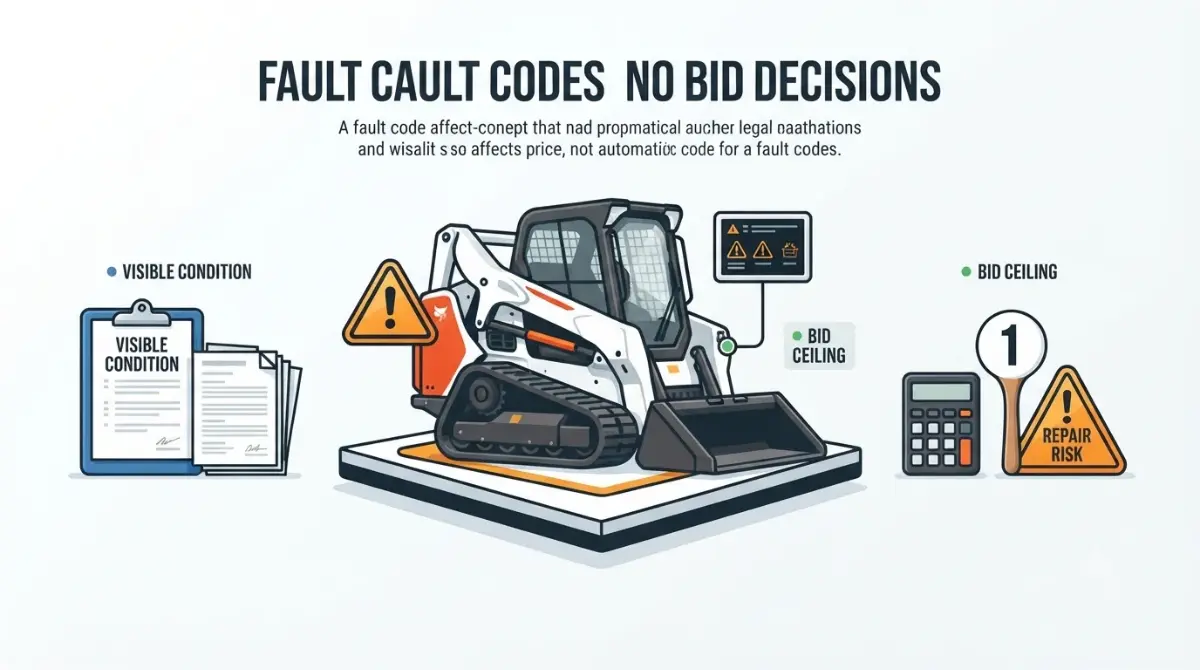
Table of Contents
A fault code on an auction Bobcat is a pricing question first and a pass signal second.
| Call | When it applies |
|---|---|
| Pass | Serial or product line unconfirmed, code unreadable, or an emissions-system code with no repair history |
| Bid to a ceiling | Code matched to this machine’s product line and priced from a dealer quote |
| Bid | A qualified reading shows no active or history codes; the sale is still as-is |
Editorial framework, not an OEM rule.
Where to jump
Closing soon? Jump to the bid-ceiling section.
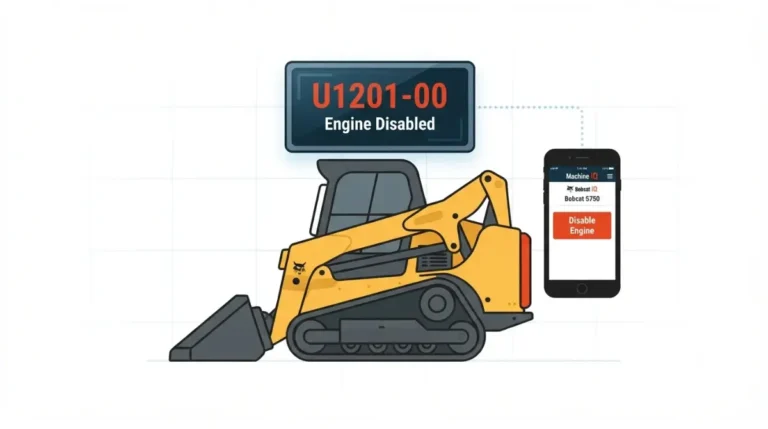
A code that has already shut the machine down is a different bid than one that logged a warning, and the severity classes by machine are in the pillar.
ℹ️ Safety Note: Auction purchases are as-is and final, so an unpriced fault becomes your cost. An unfamiliar machine can also hold stored hydraulic pressure and raised implements that crush; leave starting and diagnosis to a Bobcat-trained technician, following the manual.

What an auction listing does and doesn’t tell you
As-is in plain terms
At Ritchie Bros., every lot sells as is, where is, and all sales are final. A fault code the listing never mentions is yours once bidding closes.
What the report covers
An IronClad-certified listing carries a report on visible condition only. The policy says it is not meant to catch defects that need diagnostic equipment, excludes electrical and hydraulic systems, disclaims electronic control module and display failures, and does not guarantee hours.
What a photo shows
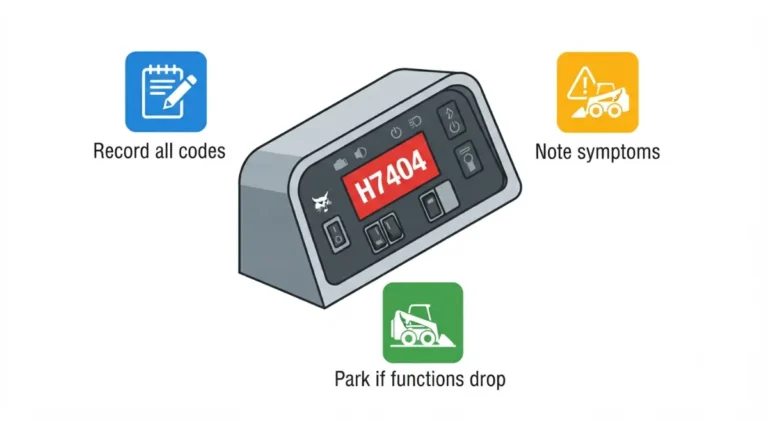
A display photo shows one screen at one moment, not code history.
Source: Ritchie Bros. Payments page and IronClad Assurance Policy (revised December 6, 2017), read October 2, 2026.
How to read a Bobcat code you see in a listing
Match code to machine
A service code means something only against a product line and a format.

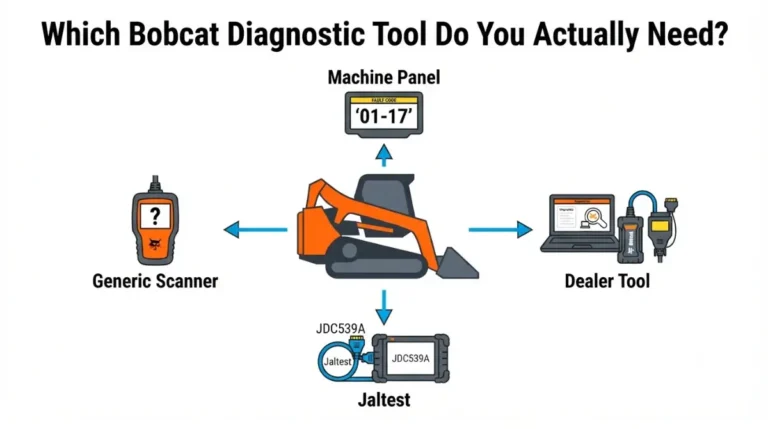
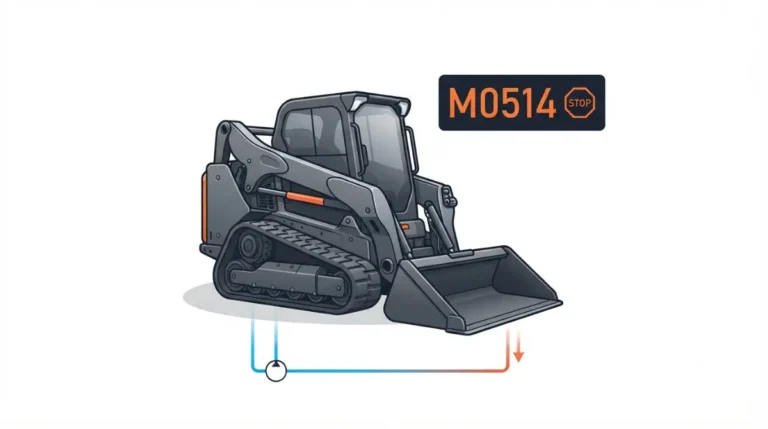
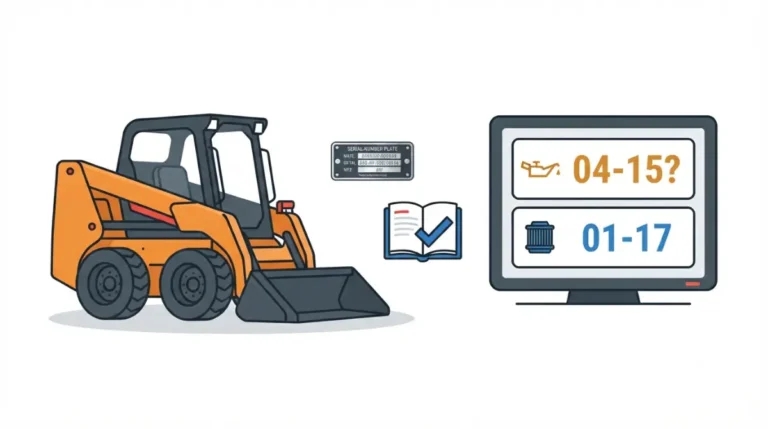
Bobcat’s Diagnostic Service Codes document is organized by product and says to check which product a duplicate code appears under. Codes also show up in different shapes, such as the 01-17 and M0117 formats. The fault code lookup by serial number shows how to place one. Detailed troubleshooting sits behind Machine IQ.
Critical or non-critical
Bobcat’s 4.3-inch display tutorial separates critical from non-critical codes, on machines with that display only.
Active versus stored
Bobcat’s display page says its instrumentation shows active and historical codes, so ask for both.
✅ Do This: Have a Bobcat-trained technician read active and history codes beside the serial plate. Never clear a code to test it.
Emissions-system codes and the tampering risk
What EPA covers
A code pointing at the emissions control system raises a second question: is every part still on the machine?
📜 The Rule: EPA bars tampering with emissions controls on nonroad equipment under Clean Air Act section 203(a)(3) and 40 C.F.R. 1068.101(b), covering particulate filters, EGR, catalysts, SCR, their sensors, and diagnostic trouble codes. Source: EPA Enforcement Alert (December 2020), checked October 2, 2026; later EPA guidance was not reviewed.
Tampering can void warranties and may leave engines uninsured.
What to confirm
Ask whether aftertreatment parts are original and in place; which engines carry them varies by model and year, so the manual for the serial decides.
🗺️ State Check: EPA says state laws vary and some bar operating, selling, or registering a tampered engine; look up your state air agency’s off-road diesel rules.
✅ Do This: Ask a compliance consultant whether such a machine can be run in your state.
Set a bid ceiling when the codes are unknown
Formula and inputs
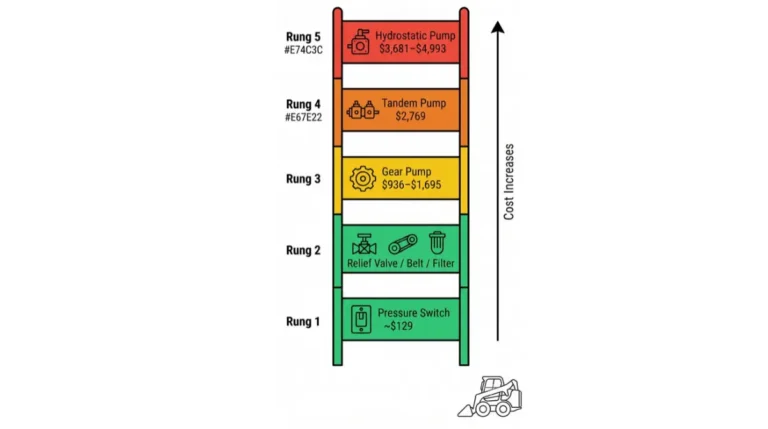
Work backward from what a sound machine is worth, then subtract what the code could cost.
Maximum bid = (V − R − T) ÷ 1.10, while the result stays at or under $30,000. V is the machine’s value with no open codes, R a dealer’s repair quote for the code, T your transport quote. Illustrative: V $28,000, R $3,500, T $900 give a maximum bid near $21,454.
🧮 Run the Numbers: Estimate V with the Used Equipment Hour-Value Estimator; have model, year, and hours ready.
Fee tiers
| Winning bid | Buyer fee | Applies to |
|---|---|---|
| $30,000 or less | 10%, minimum $100 | US and Mexico lots, events opening on or after Aug. 1, 2026 |
| $30,001 to $75,000 | 5.5%, minimum $3,000 | Same |
| Over $75,000 | $4,125 flat | Same |
Source: Ritchie Bros. Buyer Fees page, read October 2, 2026. Fees vary by region and event; sales tax is extra.
From $30,000 to about $54,545 the fee is a flat $3,000, so each extra $1,000 of bid costs exactly $1,000. Other houses charge differently.
What to verify before you bid
Questions to ask
Ask the seller these before bidding:
- What are the data-plate serial number and hour-meter reading?
- Are any service codes active or in history, and can you photograph the display beside the serial plate?
- Does an inspection report exist, and did it read codes?
In-person inspection
Bring a Bobcat-trained technician and follow the yard’s rules. Confirm the data plate matches the paperwork.
⚠️ Hazard: Raised implements and hydraulic pressure can move or drop and crush. Do not start the machine or stand under raised arms yourself.
Paid inspections
Ritchie Bros. sells enhanced inspections from the item page, described as including engine video and fluid analysis; ask whether any report reads codes.
After you win: removal deadline and transport
Removal deadline and storage
Payment is due within seven days. Each sale sets a removal deadline, and Ritchie Bros. US storage runs $25 per day after it. On IronClad lots, a dispute is due within 11 business days, or sooner if the machine leaves on your transport.
Getting it home
Size the haul with the Machine Transport Dimension & Permit Checker, which covers state thresholds; weights depend on model and configuration.
✅ Do This: Ask a licensed carrier to confirm shipping weight and who loads and secures it.
Bobcat auction fault codes: quick answers
1. Can I see a Bobcat’s fault codes before bidding at auction?
Only if the listing photos, the seller, or a paid inspection show them. IronClad reports exclude diagnostic equipment, so ask for a display reading.
2. Does a fault code make an auction Bobcat a bad buy?
Not automatically. It depends on the match to the machine, severity, any emissions link, and your price. Have a Bobcat-trained technician read it.
3. Are auction Bobcats sold as-is?
At Ritchie Bros., every item sells as is, where is, and all sales are final, so price open codes before bidding.
4. Are Bobcat fault codes the same on every model?
No. Bobcat’s code document groups codes by product and says to confirm which product a duplicate code appears under.
5. Where do I find what a Bobcat code means on my machine?
Use Bobcat’s Diagnostic Service Codes document and the machine’s manual; Bobcat points to Machine IQ for troubleshooting.
6. Does Bobcat treat critical and non-critical codes differently?
Bobcat’s tutorial separates critical from non-critical codes, but it applies only to machines with the 4.3-inch display.
7. What is the Ritchie Bros. buyer fee in the US?
For events opening from August 1, 2026, it is 10% (minimum $100) up to $30,000, then 5.5% to $75,000.
8. What should I budget for repairs on a Bobcat with open codes?
Use a dealer quote for the code you pulled, then work backward from the machine’s sound value to a maximum bid.
9. Is it legal to run a Bobcat with emissions parts removed?
EPA rules prohibit tampering on nonroad equipment, and many states add their own. Ask a compliance consultant before buying.
10. How long do I have to collect an auction machine?
Each sale sets a removal deadline; at Ritchie Bros. US sites, storage runs $25 per day after it passes.
Price the unknown. Place your code with the fault code lookup by serial number and the pillar’s severity classes by machine, then set your ceiling with the Used Equipment Hour-Value Estimator. Have a Bobcat-trained technician read the codes before you bid. This reflects documented sources, not first-hand operation.