Bobcat 04-15 Code and the Full Two-Part Format Explained

Bobcat 04-15 code lookups disagree because most published lists copy each other. Bobcat’s S220 manual confirms 01-17 as plugged air filter.
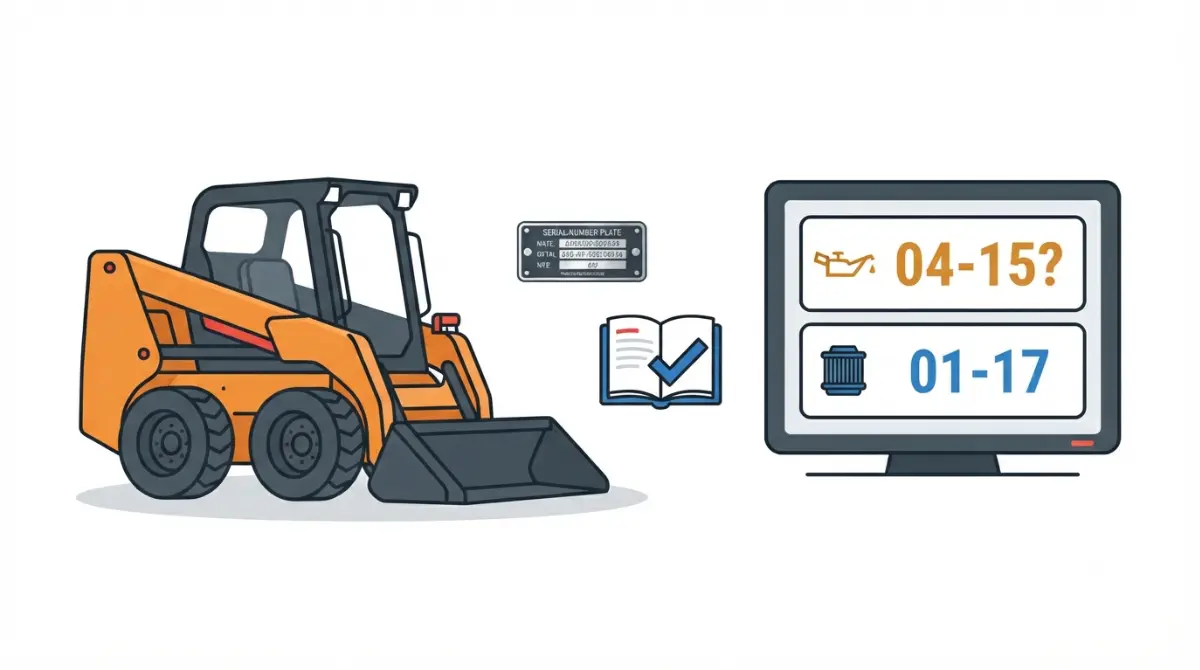
Table of Contents
On a Bobcat using the older two-part service code format, the first number is the system and the second is the condition. 01-17 is air filter, plugged — Bobcat’s S220 service manual states the code appears when the air cleaner element needs replacement. 04-15 is in the engine oil pressure group at a shutdown-level condition; we could not trace that exact wording to Bobcat literature, so confirm it against your serial-numbered manual before acting on it.
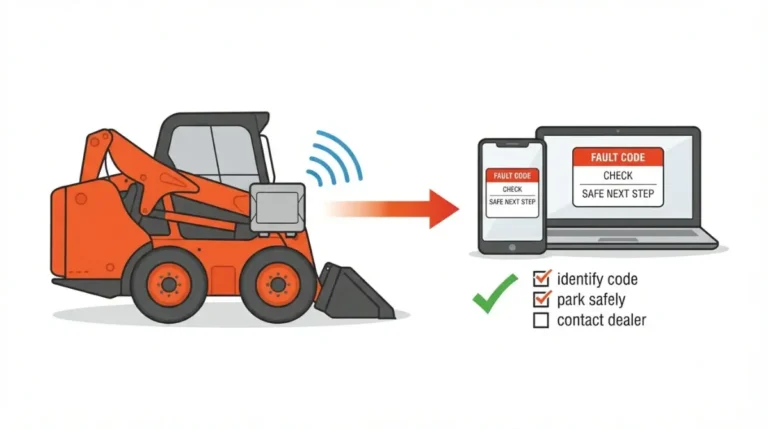
Your code isn’t one of these two? The full sourced code list for your machine covers the rest. Machine already shut itself down? Section 3. Not sure your machine even uses this format? Section 5.
What 04-15 and 01-17 tell you
A two-part code is not a diagnosis. It is the controller reporting that one monitored input crossed a threshold, which is why the same second number appears behind a dozen different first numbers.
That distinction matters most at the shutdown tier. A code in that tier means the controller reached the point where it commands the engine to stop — not that the engine has already failed, and not that the reading was correct.
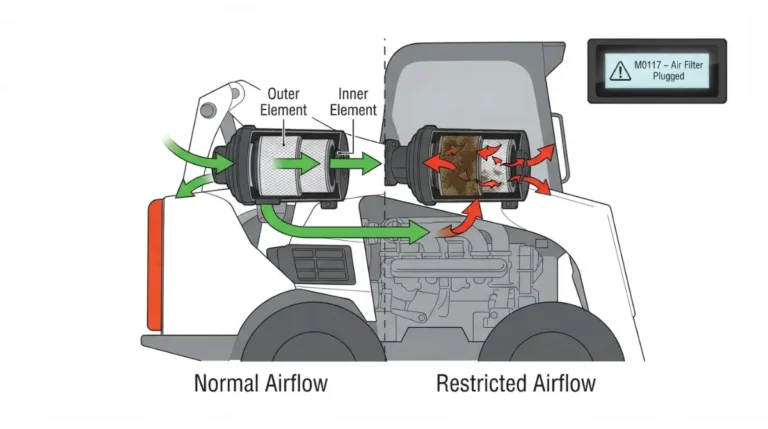
Bobcat’s S220 service manual ties 01-17 directly to air cleaner service: the code shows in the hourmeter/code display when the filter element needs replacement, and if it reappears with the engine at full RPM after the outer element is changed, the inner element is next. That is the only definition in this article confirmed against OEM literature.
ℹ️ Safety Note: A machine that reaches a shutdown-tier condition can stop with the lift arm raised and the bucket loaded, which puts a suspended implement over whatever is beneath it and leaves the operator with no hydraulics. The information here is for general understanding — have a qualified heavy equipment technician perform diagnosis and repair, and follow your machine’s service manual.
How to read any Bobcat two-part code
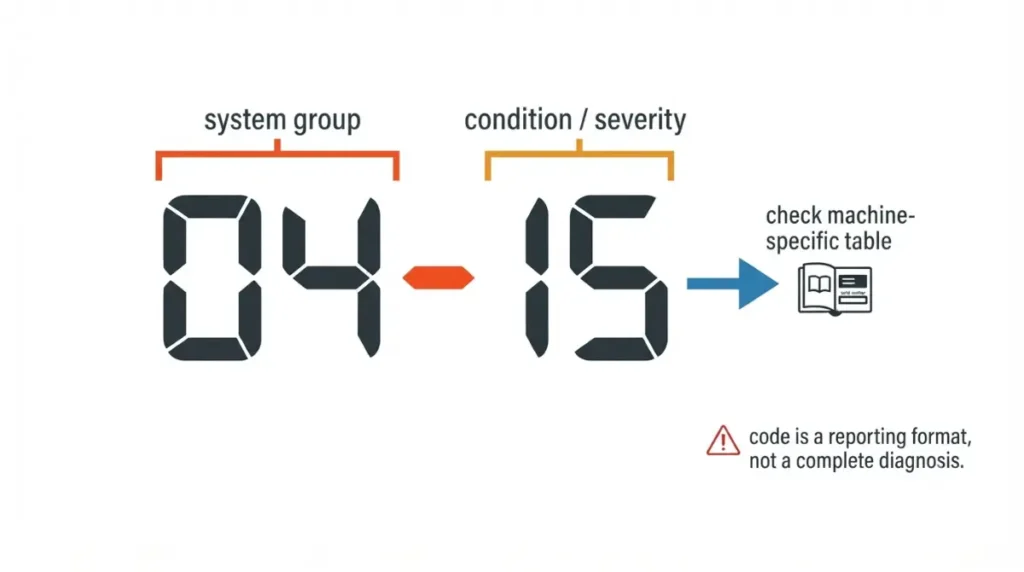
The second number is the part that repeats. Learn it once and you can parse a code that no list in your cab happens to cover.
| Second number | Condition it names | What it signals | Applies To |
|---|---|---|---|
| 09 / 10 | Low / High | Reading outside normal, machine usually keeps running | Legacy two-part-code loaders and excavators |
| 11 / 14 | Extremely High / Extremely Low | Escalated — treat as a stop-and-look | Legacy two-part-code loaders and excavators |
| 15 | In Shutdown | Shutdown-level threshold reached | Legacy two-part-code loaders and excavators |
| 16 / 17 | Not Connected / Plugged | Filter or sensor circuit condition | Legacy two-part-code loaders and excavators |
| 21 / 22 | Out of Range High / Low | Sensor signal implausible — often the sensor itself | Legacy two-part-code loaders and excavators |
| 13 / 23 | No Signal / Not In Neutral | Input missing, or a control not centered | Legacy two-part-code loaders and excavators |
| 02 / 03 / 05 / 06 / 07 | Error On / Error Off / Short To Battery / Short To Ground / Open Circuit | Output or solenoid circuit fault | Legacy two-part-code loaders and excavators |
Derived by Axle & Haul from published Bobcat loader and excavator two-part code tables, cross-checked across independently hosted copies, 19 September 2026. This is a reading aid for codes that appear on a list — it is not a method for working out what an unlisted code means.
That last sentence is not a formality. Pattern-matching a code you can’t find is exactly how a wrong repair starts.
Why a shutdown-tier code is not a warning light
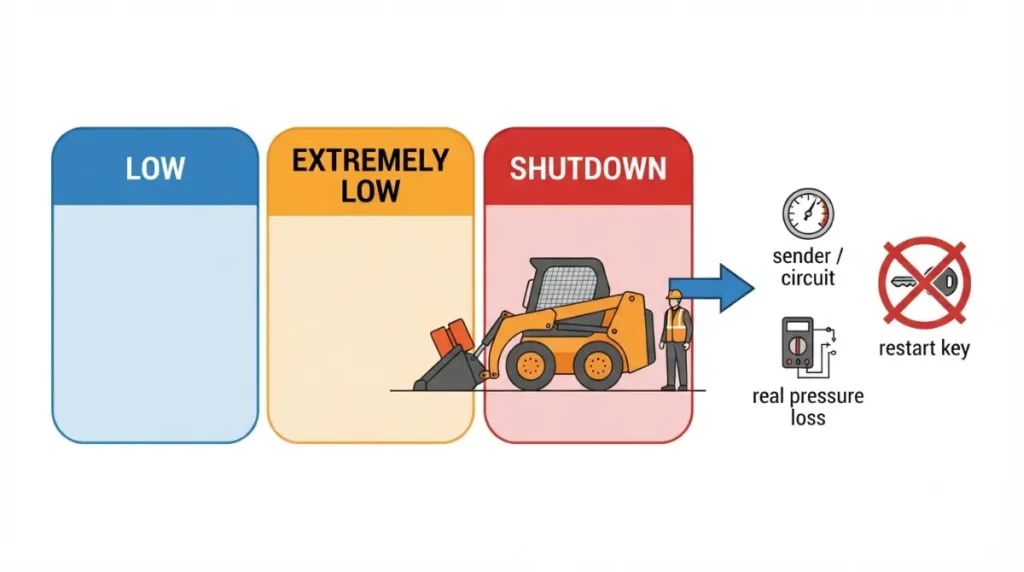
The oil pressure group runs a ladder: low, extremely low, then the shutdown-level condition. Each step is the same input reported at a worse threshold, which is why 04-15 and 04-09 are not interchangeable even though both mention the same system.
🔍 Why It Fails: A shutdown-tier oil pressure condition has two very different causes that look identical from the seat — genuine pressure loss, or a failed oil pressure switch or sender reporting a pressure that isn’t there. The controller cannot tell them apart. Neither can you, without a mechanical gauge on the port.
That is the whole reason a code is not a diagnosis, and the reason the next step is measurement rather than a restart.
⚠️ Hazard: Restarting after a shutdown-tier oil pressure condition, when the pressure loss is real, runs the bearings dry and turns a sender job into an engine job. Checking oil pressure means working at a hot engine with the machine running, which is a technician’s task on a machine secured per the manual — not a field check. Have a certified heavy equipment technician put a mechanical gauge on it before the machine runs again.
Disabling, jumpering or clearing the shutdown to finish the day is the one thing this page will not help with. It removes the protective function while leaving the cause in place.
📜 The Rule: OSHA requires heavy machinery or parts held aloft by slings, hoists or jacks to be substantially blocked or cribbed before anyone works under or between them, and blades, buckets and dump bodies to be fully lowered or blocked when being repaired or not in use, with controls neutral, motors stopped and brakes set — 29 CFR 1926.600(a)(3)(i), verified 19 September 2026. OSHA’s 11 May 2005 interpretation letter applies this section to skid-steers by name. State-plan states enforce requirements at least as strict.
✅ Do This: Ask the technician for a mechanical oil pressure reading at rated RPM before any parts are quoted, and ask whether the sender circuit was tested separately. Those two answers separate a sender job from an engine job.
01-17 and the codes that are maintenance, not failure
A 16 or 17 in the second position reports a filter or connection condition, not a shutdown condition — which is why 01-17 belongs in a different mental bucket than anything ending in 15.
📋 Verified Spec: 01-17 — Air Filter Plugged. Source: Bobcat S220 service manual, air cleaner service section. Applies to: S220, S/N 523211001 & above. Verified 19 September 2026. The manual’s sequence is outer element first; if 01-17 still shows with the engine at full RPM after that, the inner element is replaced.
Read that applicability line literally. It is confirmed for that manual and that serial range, and a loader from a different family gets confirmed against its own manual — which you can buy directly from Bobcat’s own manual store for most legacy models.
Which Bobcats use two-part codes, and what replaced them
The serial number decides this, not the model name, and the transition sits inside a specific window.
| Format | Example | Machines | Applies To |
|---|---|---|---|
| Two-part XX-XX | 04-15, 01-17 | Legacy loaders and excavators with the code display | Pre-M-Series machines |
| Alphanumeric | M0415, A8232, D0613 | M-Series and R-Series loaders, M-Series excavators, telehandlers, engine ECUs | M-Series onward |
Sources: Bobcat’s published Diagnostic Service Codes document (revised 10-20), whose contents list covers M-Series loaders S450–S850 and T450–T870, R-Series S60s–S70s and T60s–T70s, M-Series excavators E26–E85, E145 and E165, the small articulated loader, attachments, Toolcat, telehandler, compact wheel loader, and the V1 Delphi, V2 Bosch and D34 engine ECUs; verified 19 September 2026.
The M-Series arrived in stages. The first two models were the S630 skid-steer and T630 compact track loader, with the S650 and T650 following, and the S650 and T650 were orderable through dealers by late 2009. A December 2010 Bobcat dealer presentation puts the S850 and T870 at September 2010 production, the S770, T770 and A770 in March–April 2011, and the S300, T300 and A300 phased out in 2010.
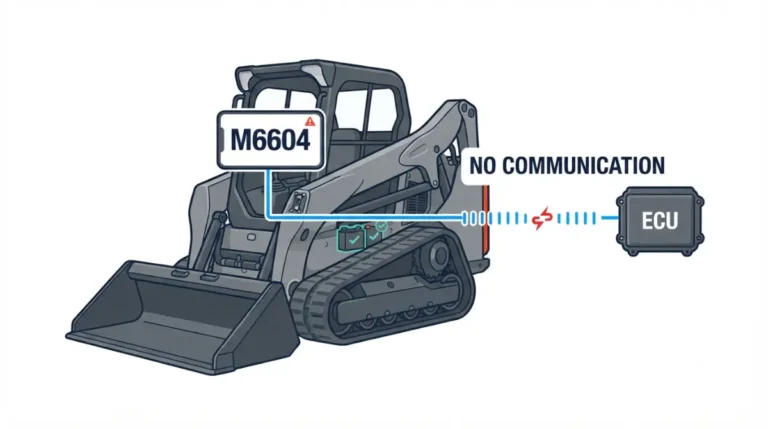
Both tables preserve the same numeric groups — 04-15 and M0415 sit in the same position in their respective lists. That is our structural observation from comparing the two published tables, not a mapping Bobcat has stated, and it is not a substitute for looking your code up in the right list.
Why two code lists give you two different answers
Most published code tables online descend from one another. The tell is in the wording: the most widely mirrored version renders conditions in machine-translated phrasing, the same phrasing appearing across sites that have no relationship to each other.
The more serious problem is that the same code genuinely means different things on different machines. On the loader table, 05-09 reads as hydraulic charge pressure low; on the excavator table, the same code reads as travel pilot pressure low, and the excavator list carries 03-15 for battery voltage in shutdown where the loader list does not.
So a list without a machine type attached to it is not a reference. Confirm yours three ways, in this order:
- Find the serial number plate and read the full number, not the model badge.
- Match it to the code list published for that machine family, then look your code up by serial number rather than by model.
- Cross-check against the Operation & Maintenance or service manual for that serial range, or your dealer’s Owner Portal access.
This is also why a generic code reader returns nothing useful here: these are proprietary Bobcat controller codes, not SAE J1939 SPN/FMI codes.
What an oil pressure shutdown is worth fixing
The repair scope decides this, and there are three of them, in ascending cost order: the sender or switch and its circuit; the oil pump, pickup or relief circuit; and internal damage from having run without pressure.
We are not publishing a dollar range here, because a national average labour figure with no region and no date attached is worth nothing to someone holding a real quote. Put your quote against your own hours instead.
🧮 Run the Numbers: The Used Equipment Hour-Value Estimator takes machine hours, model year and your quoted repair figure and puts them against current hour-value. Have all three in front of you before you run it.
✅ Do This: Ask for the repair scope in writing before authorizing anything, and ask the shop to state which of the three scopes the mechanical pressure reading actually supports. A quote that skips that step is a quote for a guess. Lead-gen disclosure: we route service and parts requests to partners and may be compensated.
Bobcat two-part code questions
1. What does 04-15 mean on a Bobcat?
It sits in the engine oil pressure group at a shutdown-level condition on published two-part tables. Confirm the exact wording in your serial-numbered manual.
2. What does 01-17 mean on a Bobcat?
Air filter plugged. Bobcat’s S220 service manual ties it to air cleaner element replacement, outer element first, inner element if it returns.
3. Can I keep running with a shutdown-tier code showing?
No. The controller has reached the threshold where it stops the engine, and the cause is still unknown. Have a technician measure actual pressure first.
4. What is the difference between 04-09, 04-14 and 04-15?
Same system, three thresholds: low, extremely low, then the shutdown-level condition. The second number carries the severity, not the first.
5. Which Bobcats use two-part service codes?
Pre-M-Series loaders and excavators with the code display. M-Series and later machines use alphanumeric codes such as M0415.
6. Is 04-15 the same as M0415?
The two published lists place them in the same numeric group. That is our comparison of the tables, not a Bobcat-stated mapping.
7. Why do two code lists give different meanings for the same code?
Because loader and excavator controllers assign the same code differently — 05-09 is charge pressure on one list, travel pilot pressure on the other.
8. Are Bobcat two-part codes SAE J1939 codes?
No. They are proprietary Bobcat controller codes, which is why a generic J1939 reader returns nothing for them.
9. How do I confirm the code my machine is actually showing?
Read the full serial number, match it to the code list for that machine family, then cross-check the manual for that serial range.
10. Does a shutdown-tier oil pressure code always mean engine damage?
No. A failed sender or its circuit produces the same code as genuine pressure loss. A mechanical gauge reading separates them — have a technician take it.
Before you turn the key again
If the machine shut itself down, you are one measurement away from knowing whether this is a sender or an engine — and that measurement is the only thing that should happen next.
The follow-up most operators search within a minute of this page is whether the sender is lying. It is a real possibility and a common one, and the answer is a mechanical gauge reading at rated RPM taken by a certified heavy equipment technician, not a restart. Ask for that reading and the sender circuit test before any parts are quoted.
For every other code on your panel, the code list for your serial number is the place to start.
Everything here is traceable to a named source: the 01-17 definition to Bobcat’s S220 service manual, the OSHA requirement to 29 CFR 1926.600(a)(3)(i), the model-transition dates to dated trade and dealer documentation. Where we could not confirm a definition against manufacturer literature — as with the exact wording behind 04-15 — we have said so rather than repeat what the circulating lists claim. This article reflects documented sources, not first-hand operation of the equipment described.