John Deere 700L Weight for XLT and LGP, Sourced to Deere

John Deere 700L weight for XLT and LGP from Deere’s 23-09 sheet, plus option adders, a conflict table and the width and tie-down checks for hauling.
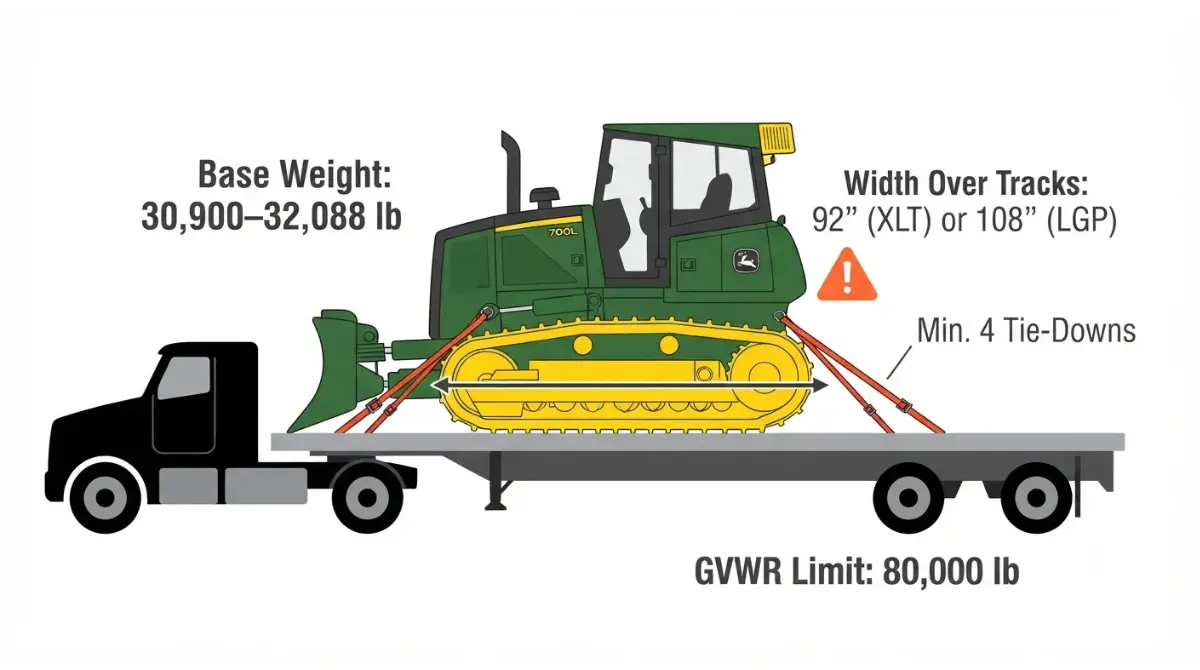
Table of Contents
John Deere 700L weight by setup
Deere lists the John Deere 700L at 30,900–32,088 lb (14,016–14,555 kg), depending on undercarriage: 30,900–30,973 lb on the XLT and 31,943–32,088 lb on the LGP. Those figures assume standard equipment, ROPS, a full fuel tank and a 175 lb operator. A ripper, cab or rock guards add more, and a certified scale ticket, not a brochure, sets the weight you haul.
| Undercarriage | Standard shoes | Base weight (two values each) | Applies To |
|---|---|---|---|
| XLT | 22 in (559 mm) | 30,900 and 30,973 lb (14,016 and 14,049 kg) | 700L XLT, Deere sheet 23-09 |
| LGP | 30 in (760 mm) | 31,943 and 32,088 lb (14,489 and 14,555 kg) | 700L LGP, Deere sheet 23-09 |
Source: Deere 700L spec sheet, form DKALDZR700 (23-09) and Deere’s 700L product page, verified October 8, 2026. The sheet states no serial range, so confirm against the machine’s own documentation.
Hauling one? Go to the width and tie-down sections; buying or specifying, start with the option weights. The rest of Deere’s crawler line is in the Deere construction equipment specs by configuration reference.
ℹ️ Safety Note: A brochure weight is not a hauling weight. Using it to pick a trailer can overload axles or the trailer, and a tracked machine that is not properly restrained can shift or fall in transit, crushing anyone nearby. This article is general understanding; have a licensed carrier or certified rigger plan and perform the move.
700L XLT vs LGP: weight, width and ground pressure
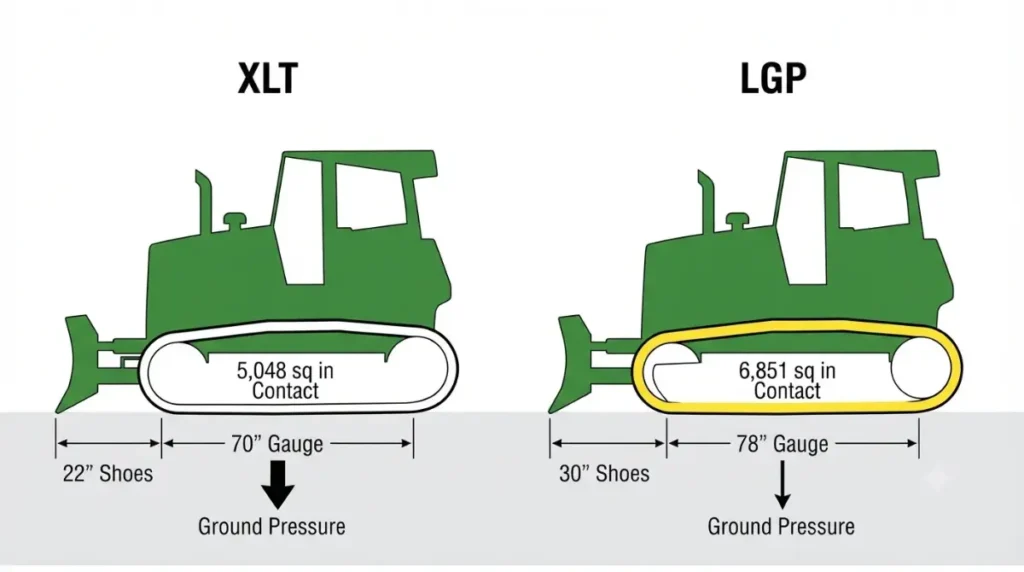
The LGP carries 970–1,188 lb more base weight than the XLT, on wider shoes and a wider track gauge.
| Undercarriage | Base weight | Shoes / gauge | Width over track | Applies To |
|---|---|---|---|---|
| XLT | 30,900–30,973 lb | 22 in (559 mm) / 70 in (1,778 mm) | 92 in (2,338 mm) | 700L XLT |
| LGP | 31,943–32,088 lb | 30 in (760 mm) / 78 in (1,981 mm) | 108 in (2,741 mm) | 700L LGP |
Source: Deere 700L spec sheet DKALDZR700 (23-09), verified October 8, 2026.
XLT: 22-inch shoes, 70-inch gauge
The XLT puts 5,048 sq in of shoe on the ground. Track length on the ground is 103 in (2,615 mm) on both undercarriages.
LGP: 30-inch shoes, 78-inch gauge
The LGP puts 6,851 sq in on the ground. The next section shows what shoe width alone changes.
Blade widths and weights
Deere prints two base weights per undercarriage and four power-angle-tilt blades, but does not label which weight goes with which blade. That is why this article gives each undercarriage as a range.
| Blade width | Blade weight | Width, blade angled 25° | Applies To |
|---|---|---|---|
| 121 in (3,077 mm) | 1,788 lb (811 kg) | 111 in | XLT |
| 127 in (3,231 mm) | 1,861 lb (844 kg) | 115 in | XLT |
| 133 in (3,383 mm) | 1,929 lb (875 kg) | 120 in | LGP |
| 145 in (3,688 mm) | 2,075 lb (941 kg) | 131 in | LGP |
Source: Deere 700L spec sheet DKALDZR700 (23-09), blade table, verified October 8, 2026.
What a ripper, winch and options add in pounds
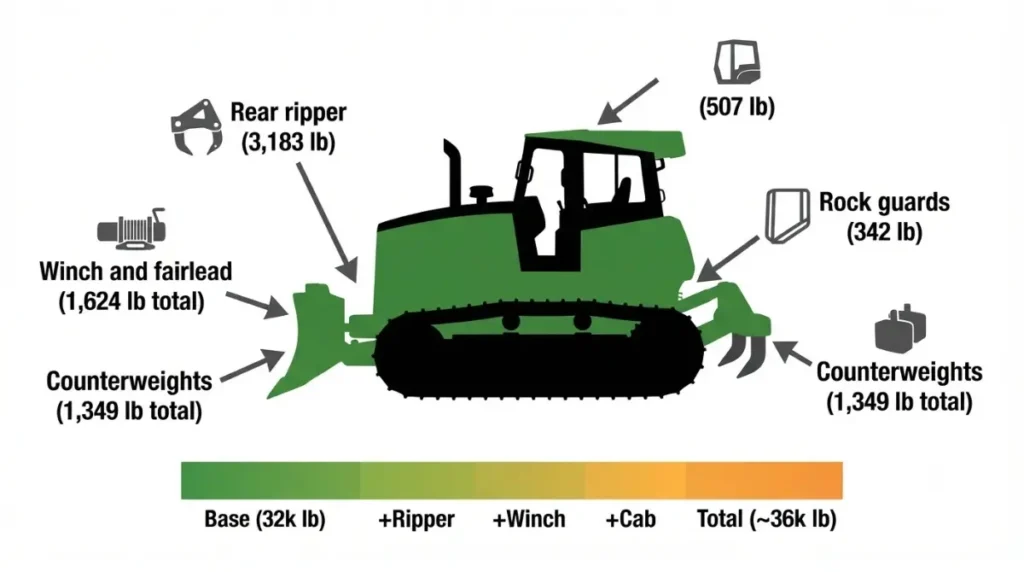
Deere lists each option’s weight separately, so a configured 700L is base weight plus whatever is bolted on.
| Option | Weight added | Applies To |
|---|---|---|
| Rear ripper (5 pockets, 3 shanks) | 3,183 lb (1,444 kg) | 700L XLT and LGP |
| Winch | 1,437 lb (652 kg) | 700L XLT and LGP |
| 4-roller fairlead | 187 lb (85 kg) | 700L XLT and LGP |
| Rear counterweight | 1,032 lb (468 kg) | 700L XLT and LGP |
| Front counterweight | 317 lb (144 kg) | 700L XLT and LGP |
| Full-length rock guards | 342 lb (155 kg) | 700L XLT and LGP |
| Cab with pressurizer, heater and air conditioner | 507 lb (230 kg) | 700L XLT and LGP |
| Limb risers (canopy and cab) | 401 lb (182 kg) | 700L XLT and LGP |
Source: Deere 700L spec sheet DKALDZR700 (23-09), optional components, verified October 8, 2026.
Ripper, winch and counterweights
The ripper is the heaviest single option at 3,183 lb, more than twice the 1,437 lb winch.
Undercarriage and shoe changes
Maximum Life undercarriage adds 465 lb (211 kg). On an LGP, 22 in shoes take 1,118 lb off the 30 in base and 24 in shoes take off 864 lb.
Worked example with inputs shown
| Setup | Inputs | Total | Applies To |
|---|---|---|---|
| A | 30,900 base + 3,183 ripper | 34,083 lb | 700L XLT, lighter base |
| B | 32,088 base + 3,183 ripper + 342 rock guards + 507 cab | 36,120 lb | 700L LGP, heavier base |
These are operating-weight sums, not scale weights. Deere’s sheet does not total combinations, so weigh the finished machine.
Why 700L weights differ from site to site
Deere’s number is an operating weight with stated conditions, and many figures online drop the conditions or change the unit.
| Figure you may see | What it is | Applies To |
|---|---|---|
| “14.56 tons” | 14,555 kg written in metric tonnes: 32,088 lb, or 16.04 US short tons | Heaviest LGP base weight |
| “806 mm track width” | Deere’s ripper shank spacing; track gauge is 1,778 mm (XLT) or 1,981 mm (LGP) | All 700L |
| “21,165 lb” | Not a Deere figure; seen in marketplace listings on October 8, 2026, 9,735–10,923 lb below Deere’s base range | Listings for 2023 and 2025 units |
| “31,943 lb” alone | One of four base weights, the lighter LGP value | 700L LGP |
Source: Deere 700L spec sheet DKALDZR700 (23-09) and Deere’s online compare table; conversions computed October 8, 2026; third-party listings observed October 8, 2026, shown as examples only.
What operating weight includes
Deere’s base weight covers standard equipment, a ROPS, a full fuel tank and a 79 kg (175 lb) operator. Options come on top. A scale reading also moves with fuel level and whatever is left on the machine, so the certified scale ticket is the number to haul on.
Tons vs tonnes
Deere’s 14,555 kg is about 14.6 metric tonnes and 16.04 US short tons. Reading “14.56 tons” as short tons would put the machine about 2,968 lb light.
✅ Do This: Ask a Deere dealer to run the machine’s serial number for open product-safety notices. This article does not state recall status.
Is a 700L legal width for hauling?
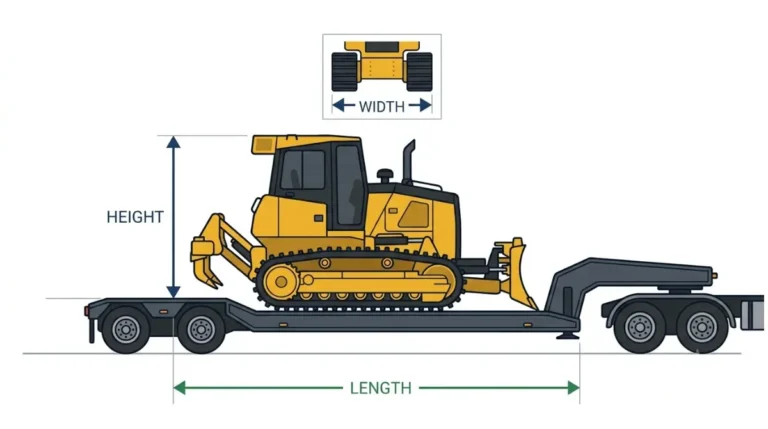
On Deere’s numbers, the XLT’s tracks sit under the 102-inch federal width baseline, the LGP’s tracks sit over it, and every blade width Deere lists sits over it.
| Setup | Width | Against 102 in | Applies To |
|---|---|---|---|
| XLT tracks | 92 in (2,338 mm) | 10 in under | 700L XLT |
| LGP tracks | 108 in (2,741 mm) | 6 in over | 700L LGP |
| XLT blades, angled 25° | 111–115 in | 9–13 in over | XLT, 121 or 127 in blade |
| LGP blades, angled 25° | 120–131 in | 18–29 in over | LGP, 133 or 145 in blade |
Source: Deere 700L spec sheet DKALDZR700 (23-09); 23 CFR 658.15; verified October 8, 2026.
Width over track vs 102 inches
📜 The Rule: Under 23 CFR 658.15(a), states may not set a width limit other than 102 inches (2.6 m) on the National Network, and 658.15(c) lets a state grant special-use permits above 102 inches. Wider machines therefore move on state-issued permits. Verified October 8, 2026 (eCFR current as of October 6, 2026).
Blade fitted: angled widths
Deere’s sheet gives each width with the blade angled 25°. How a blade is set for the haul is a decision for the carrier and the operator’s manual, not a step this article covers.
Two state examples
🗺️ State Check: Federal baseline: 102 inches. Texas lists 8 ft 6 in (102 in) as the width allowed without a permit for non-passenger vehicles and loads (TxDMV size and weight limits, no date shown). Ohio sets 102 inches including load (Ohio Revised Code 5577.05, effective July 1, 2013). Both match the federal baseline, so an LGP or a blade-fitted 700L is overwidth in each. Permit tiers, escort triggers and travel-time limits above 102 inches are set state by state and are not covered here; ask each state on the route for them at your widest dimension. Verified October 8, 2026.
⚠️ Hazard: An overwidth machine can strike oncoming traffic, bridge rails and roadside objects, and a move without the right permit can be stopped and cited. The widest point changes with how the blade is set. A licensed heavy-haul carrier should measure the machine as it will ride and secure the permits.
🧮 Run the Numbers: In the Machine Transport Dimension & Permit Checker, enter width over track, blade width as it will ride, and overall length: 16 ft 1 in (4,906 mm) with the blade straight, 18 ft 0 in (5,474 mm) with a winch and fairlead rollers.
✅ Do This: Give the carrier the measured width with the blade as it will ride, the shoe width fitted and every option, and ask which permits and escorts each state on the route requires at that width.
Trailer sizing and tie-downs for a 700L
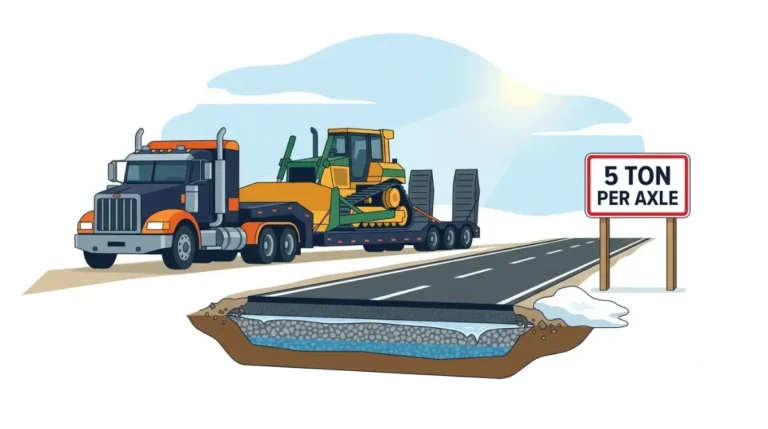
Federal limits cap the whole rig at 80,000 lb, and the machine alone takes 30,900–36,120 lb of that across this article’s examples.
| Limit | Federal figure | Applies To |
|---|---|---|
| Gross vehicle weight | 80,000 lb | Interstate System and reasonable access |
| Single axle | 20,000 lb | Interstate System and reasonable access |
| Tandem axle | 34,000 lb | Interstate System and reasonable access |
Source: 23 CFR 658.17, eCFR current as of October 1, 2026; verified October 8, 2026.
80,000 / 20,000 / 34,000 lb limits
📜 The Rule: 23 CFR 658.17 sets these weights for the Interstate System and reasonable access to it, and 658.17(h) lets states issue special permits beyond the axle, gross and bridge-formula limits for nondivisible loads. A single axle over 20,000 lb or a tandem over 34,000 lb is over the federal limit even when the gross is under 80,000 lb. Verified October 8, 2026.
Headroom formula with the machine side filled in
80,000 lb − machine weight − tractor and trailer weight = gross headroom.
| Applies To | Machine weight | Left under 80,000 lb |
|---|---|---|
| Lightest base, 700L XLT | 30,900 lb | 49,100 lb |
| Heaviest base, 700L LGP | 32,088 lb | 47,912 lb |
| XLT with ripper (Section 3, setup A) | 34,083 lb | 45,917 lb |
| LGP with ripper, rock guards, cab (setup B) | 36,120 lb | 43,880 lb |
Source: Deere spec sheet weights as totaled in Section 3; 23 CFR 658.17; arithmetic checked October 8, 2026.
Tractor and trailer weights come out of that remainder. They are not published here, so read them from the plates or a scale ticket. Axle loads depend on where the machine sits on the trailer, which a gross figure cannot show.
🧮 Run the Numbers: In the Axle Weight Distribution Calculator, enter the machine’s scale-ticket weight, the tractor and trailer weights, and the axle spacing.
Minimum tie-downs under 393.130
📜 The Rule: 49 CFR 393.130 covers heavy equipment on wheels or tracks, bulldozers included, at 10,000 lb or more. Accessory equipment must be completely lowered and secured, and the machine must be restrained against lateral, forward, rearward and vertical movement with at least four tiedowns, each as close as practicable to the front and rear or at mounting points made for the purpose. Verified October 8, 2026 (eCFR current as of October 6, 2026; see 49 CFR 393.130).
Four is a minimum, not a securement plan.
⚠️ Hazard: A tracked machine that is not restrained in all four directions can shift or leave the trailer in a hard stop or turn, and an axle over its federal limit puts the carrier out of compliance. This article does not cover loading, unloading or tiedown placement. A licensed carrier or certified rigger should plan and perform the move.
✅ Do This: Ask the carrier for the machine’s loaded scale weight, the trailer’s own weight and rated capacity, the axle loads they expect, and the number and rating of the tiedowns they will use.
XLT, LGP or 750L: which weight class fits
Ground pressure and base weight separate the three choices.
| Machine | Base weight | Ground pressure | Applies To |
|---|---|---|---|
| 700L XLT | 30,900–30,973 lb | 6.12–6.14 psi (42.2–42.3 kPa) | 22 in shoes |
| 700L LGP | 31,943–32,088 lb | 4.66–4.68 psi (32.1–32.3 kPa) | 30 in shoes |
| 750L | 37,569–40,040 lb (17,041–18,162 kg) | Not covered here | Deere sheet DKALDZR750 (23-09), range only |
Source: Deere 700L spec sheet DKALDZR700 (23-09) and Deere 750L spec sheet DKALDZR750 (23-09), verified October 8, 2026.
Ground pressure: 6.12–6.14 psi vs 4.66–4.68 psi
Ground pressure is base weight over contact area: 30,900 lb over 5,048 sq in is 6.12 psi, and 31,943 lb over 6,851 sq in is 4.66 psi. The LGP weighs more and presses about 1.5 psi less.
700L vs 750L weight gap
The lightest 750L base weight, 37,569 lb, is 5,481 lb above the heaviest 700L base. Net power is 175 hp on the 750L against 135 hp on the 700L.
John Deere 700L weight FAQ
1. How much does a John Deere 700L weigh?
Deere lists the 700L at 30,900–32,088 lb (14,016–14,555 kg) as a base operating weight, depending on undercarriage and before options.
2. How much does a 700L XLT weigh?
Deere lists the 700L XLT at 30,900–30,973 lb (14,016–14,049 kg) with standard equipment, ROPS, full fuel and a 175 lb operator.
3. How much does a 700L LGP weigh?
Deere lists the 700L LGP at 31,943–32,088 lb (14,489–14,555 kg) on the same base conditions, with 30 in shoes standard.
4. What does the 700L operating weight include?
Standard equipment, a ROPS, a full fuel tank and a 175 lb (79 kg) operator; options such as a ripper or cab add weight.
5. How much does a 700L ripper add?
Deere’s sheet lists the rear ripper at 3,183 lb (1,444 kg), the heaviest single option in this article’s table.
6. Is 700L weight in tons or tonnes?
Deere’s 14,555 kg is about 14.6 metric tonnes, 16.04 US short tons or 32,088 lb, so confirm which ton a source means.
7. How wide is a 700L for hauling?
Track width is 92 in (XLT) or 108 in (LGP); with Deere’s blades angled, overall width is 111–131 in. The carrier should measure it.
8. Does a 700L need an oversize permit?
Over 102 in moves on a state special-use permit; the LGP’s 108 in tracks and every listed blade width exceed that. Ask the carrier.
9. How many tie-downs does a 700L need?
49 CFR 393.130 requires at least four tiedowns for tracked equipment of 10,000 lb or more. A carrier or certified rigger sets the full plan.
10. What is the 700L’s ground pressure?
Deere lists 6.12–6.14 psi (42.2–42.3 kPa) on the XLT and 4.66–4.68 psi (32.1–32.3 kPa) on the LGP.
Where this leaves you
You have Deere’s weight for each setup and the limits it runs into. The next question is the trailer: start from the machine’s scale-ticket weight, add the tractor and trailer, and test the total against 80,000 lb and the axle limits in the Axle Weight Distribution Calculator. The other Deere crawlers are in the Deere construction equipment specs by configuration reference.
Before any move, ask a licensed heavy-haul carrier for the loaded weight, the width as it will ride and the tiedown plan. This article reflects documented sources, not first-hand operation of the equipment described.