How to haul a John Deere 850L on a lowboy trailer

An 850L rides on 130 in of track, so ask for a lowboy’s rating at that length. Weights, deck heights and axle limits for each John Deere 850L setup.
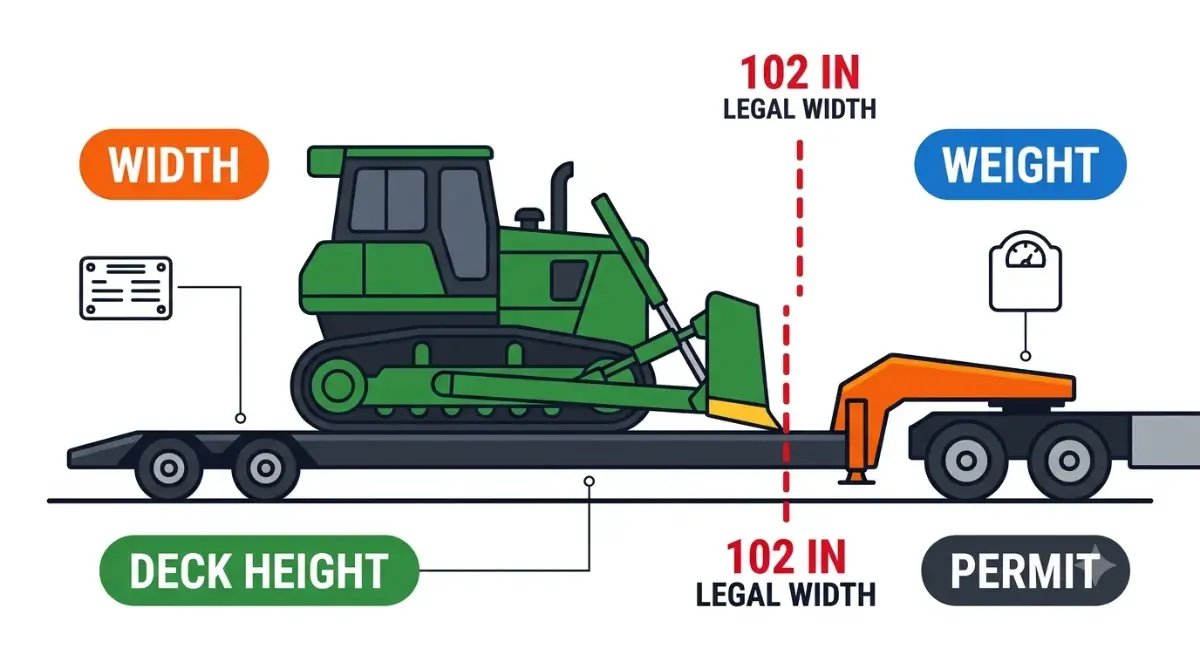
Table of Contents
Specs and rules checked on October 27, 2026.
A John Deere 850L weighs 47,578 to 56,115 lb by setup, and with the blade on it is wider than 102 in in every configuration. On a lowboy deck no higher than 30.3 in, it stays under 13 ft 6 in tall, so width and weight decide how it moves.
850L hauled weight by undercarriage and blade
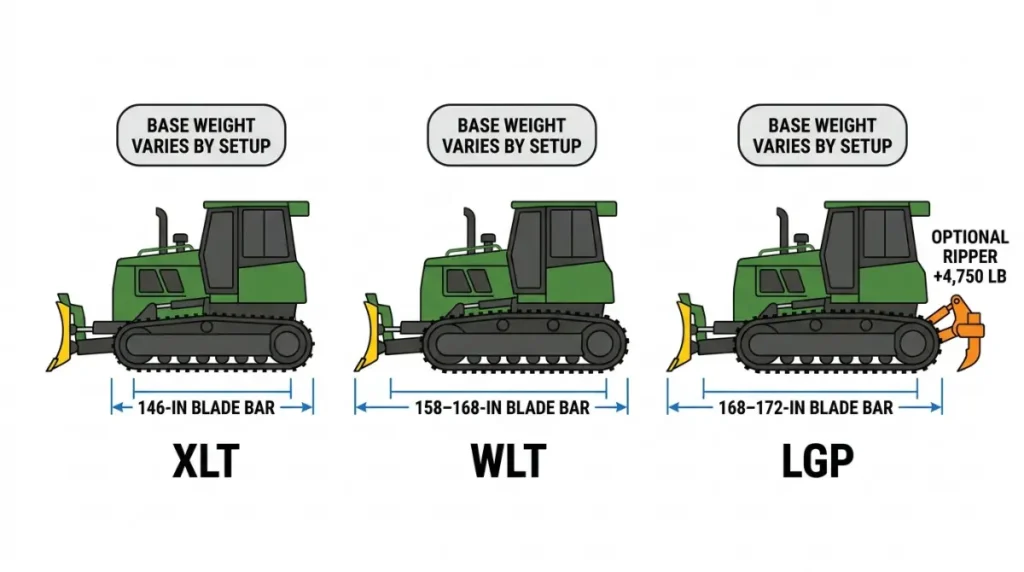
Deere’s 850L spec sheet, DKALDZR850 (23-09), lists six setups. Each one pairs an undercarriage with either a power-angle-tilt (PAT) blade on a C-frame or an outside dozer (OSD) blade on a push-beam.
| Applies to (850L setup) | Base weight, lb | Width, blade straight | Width over tracks | Blade and frame off, lb |
|---|---|---|---|---|
| PAT XLT, 146-in blade | 48,779 | 146 in (12 ft 2 in) | 108 in (9 ft 0 in) | 42,125 |
| PAT WLT, 158- or 168-in blade | 50,250–50,325 | 158–168 in | 120 in (10 ft 0 in) | 43,274–43,496 |
| PAT LGP, 168- or 172-in blade | 51,313–51,365 | 168–172 in | 132 in (11 ft 0 in) | 44,337 |
| OSD XLT, 129-in semi-U | 47,578 | 129 in (10 ft 9 in) | 98 in (8 ft 2 in) | 40,146 |
| OSD WLT, 141-in semi-U | 49,400 | 141 in (11 ft 9 in) | 110 in (9 ft 2 in) | 41,697 |
| OSD LGP, 153-in semi-U | 51,356 | 153 in (12 ft 9 in) | 122 in (10 ft 2 in) | 43,265 |
Source: Deere DKALDZR850 (23-09). Base weight is with ROPS and full fuel, plus a 175-lb operator (21,581–23,299 kg). The last column subtracts the blade and its C-frame or push-beam. Deere doesn’t pair its two WLT weights to the two WLT blades, so that row is a range.
XLT is the extra-long track, WLT the wide long track, LGP low ground pressure. Base shoes run from 24 in on the XLT to 36 in on the LGP, which is the quickest way to tell them apart in a yard.
Options add weight. A three-shank ripper adds 4,750 lb, and limb risers add 1,061 lb. The heaviest build on Deere’s sheet, an LGP with the 172-in PAT blade and a ripper, comes to 56,115 lb before rock guards or screens.
Deere sells the 850 P-Tier at the same base weights. The Deere specs by configuration cover the rest of the dozer line.
Which lowboy carries an 850L?
Start with the trailer’s capacity plate, and read it in pounds against a deck length.
Capacity over 130 in of track
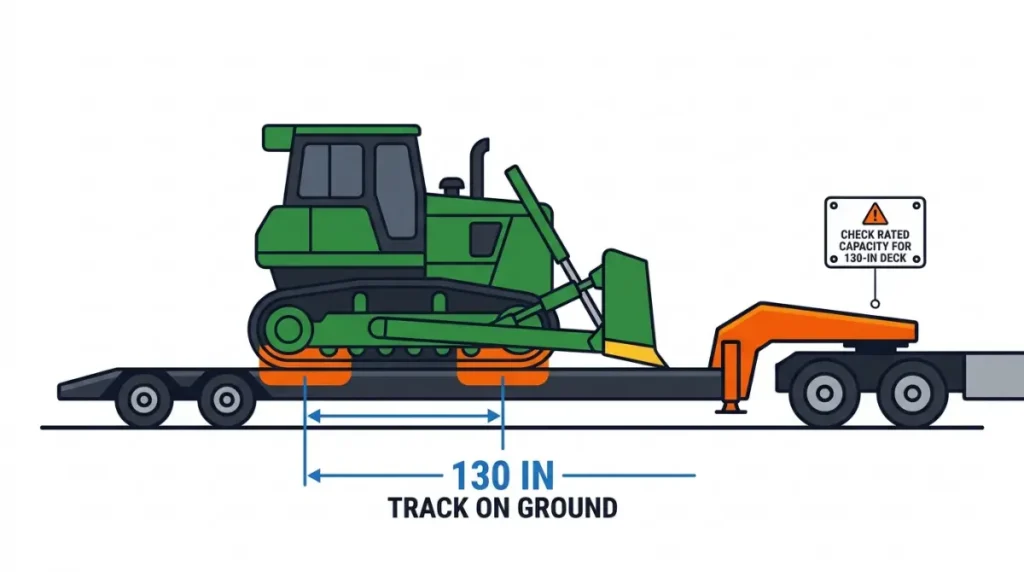
Every 850L undercarriage carries its weight on 130 in (3,300 mm) of track on the ground (DKALDZR850). A capacity figure means little without the deck length it applies to. The number to get from the trailer’s maker is its rated capacity with the load on 130 in of deck.
If the plate gives tons, convert before comparing. A US short ton is 2,000 lb and a metric tonne is 2,204.6 lb. On a plate reading 55, that gap is 11,254 lb.
Deck length
With a PAT blade the 850L is 225 in (18 ft 9.5 in) long. With an OSD blade it is 233 in (19 ft 5 in).
The ripper’s own length is 64 in lowered. No end-to-end length with a ripper fitted appears on the sheet, so measure a ripper machine before you book the deck.
Loaded height on the deck
Height to the roof is 3,344 mm (11 ft 0 in), taken with the antenna base and grousers and with the antenna whip removed. Limb risers raise it to 3,438 mm (11 ft 3 in).
Loaded height is that figure plus deck height:
- Under a 13 ft 6 in legal height, the deck can be up to 30.3 in, or 26.6 in with limb risers.
- Under 14 ft 0 in, the limits are 36.3 in and 32.6 in.
Before you load: Deere’s figure is for the machine as built. A grade-control mast or a beacon mounted higher adds to it, so measure the machine at its highest point once it sits on the deck, before the route is planned.
Gross weight runs out before trailer capacity does
A trailer rated well above the 850L’s weight can still put the load over the road limits. On the Interstate, 23 CFR 658.17 caps gross weight at 80,000 lb and lets states permit nondivisible loads above it. Single axles stop at 20,000 lb and tandems at 34,000 lb.
| Applies to (850L setup) | Machine weight, lb | Left for tractor and trailer, lb |
|---|---|---|
| LGP, 172-in PAT blade, three-shank ripper | 56,115 | 23,885 |
| OSD XLT, 129-in blade fitted | 47,578 | 32,422 |
| OSD XLT, no blade or push-beam | 40,146 | 39,854 |
Machine weights from DKALDZR850 (23-09). The last column is 80,000 lb minus machine weight.
Next, subtract your rig’s tare weight, the empty weight of tractor and lowboy from a scale ticket. What’s left shows whether the gross is legal or the load needs an overweight permit.
Axle groups carry their own limits. The federal Bridge Table allows 42,500 lb on three axles spread 9 ft from first to last. That is the spread of a tri-axle lowboy with 54-in axle spacing.
Lift the third axle and the remaining pair counts as a tandem, held to 34,000 lb. A trailer axle rated above those numbers doesn’t raise them.
Spring thaw cuts axle limits further on posted roads in states such as Michigan. The frost-law axle cuts by state compare five states.
Chain ratings for a 56,115-lb 850L
49 CFR 393.130 requires at least four tiedowns on tracked machinery of 10,000 lb or more, with accessory equipment fully lowered and secured. Four sets the count.
Strength comes from a second rule in Part 393. A chain run direct from trailer to machine is credited at half its marked working load limit (WLL), and the credited total must reach half the machine’s weight. In practice, the marked WLLs of direct-tied chains must add up to the machine’s full weight.
For the 56,115-lb build:
- Four ½-in Grade 70 chains at 11,300 lb each total 45,200 lb, which is 10,915 lb short.
- Four ½-in Grade 100 chains at 15,000 lb each total 60,000 lb and clear it.
The chain-rating math worked for the 700L carries the federal chain table and the rules on binders and anchors. The method is the same at 850L weights.
Ask a certified rigger or DOT compliance consultant which of your tiedowns count as direct, and whether the credited total clears the machine’s scale weight.
When does an 850L need no permit at all?
If the blade stays on, it always needs a width permit. Deere lists blade widths of 129 to 172 in straight, and 132 to 155 in with the PAT blade angled 25 degrees (DKALDZR850).
Every one of those widths is past the 102 in that 23 CFR 658.15 sets on the National Network, where states may permit wider loads.
The one setup that comes in at 98 in
With its blade and push-beam removed, the OSD XLT measures 98 in over the tracks. The other five setups still run 108 to 132 in wide on bare tracks.
That stripped OSD XLT weighs 40,146 lb and fits under 13 ft 6 in on a deck up to 30.3 in. If your rig’s scale weights stay inside the gross and axle limits, it moves as a legal-size, legal-weight load on roads where 102 in applies. The 7,432-lb blade and push-beam go on a second truck.
Hazard: An 850L blade with its C-frame or push-beam weighs 6,654 to 8,091 lb and can drop or swing once it is unpinned. Removal and refitting are work for a Deere dealer technician following the operator’s manual.
Removability also matters for an overweight permit. For overweight permits on the Interstate, 23 CFR 658.5 treats a load as nondivisible if separating it would compromise its use, destroy its value or take more than 8 workhours with appropriate equipment. The applicant carries the burden of proof on the hours.
Ask each route state’s permit office whether your 850L’s blade must come off before it issues an overweight permit, and have the answer written on the permit.
Escort triggers, legal heights and blade rules differ by state. The permit, height and blade rules by state compare nine of them.
Send the carrier your serial plate and scale ticket
A licensed heavy-haul carrier quotes and files permits from the numbers you send, so have these ready:
- Serial number and undercarriage (XLT, WLT or LGP)
- Blade type and width, and whether it rides on the machine
- Ripper, limb risers or rock guards fitted
- The machine’s weight from a scale ticket
- Every state on the route
Then ask the carrier for two figures in writing: the trailer’s rated capacity with the load on 130 in of deck, and the scaled axle weights of the loaded rig.