Which Deere Dozers Need an Oversize Permit to Stay Legal by State

Oversize permits for Deere dozers start with width: a standard-blade 450 P-Tier (97 in) is legal, a 550 P-Tier (105 in) is not. Height and weight next.
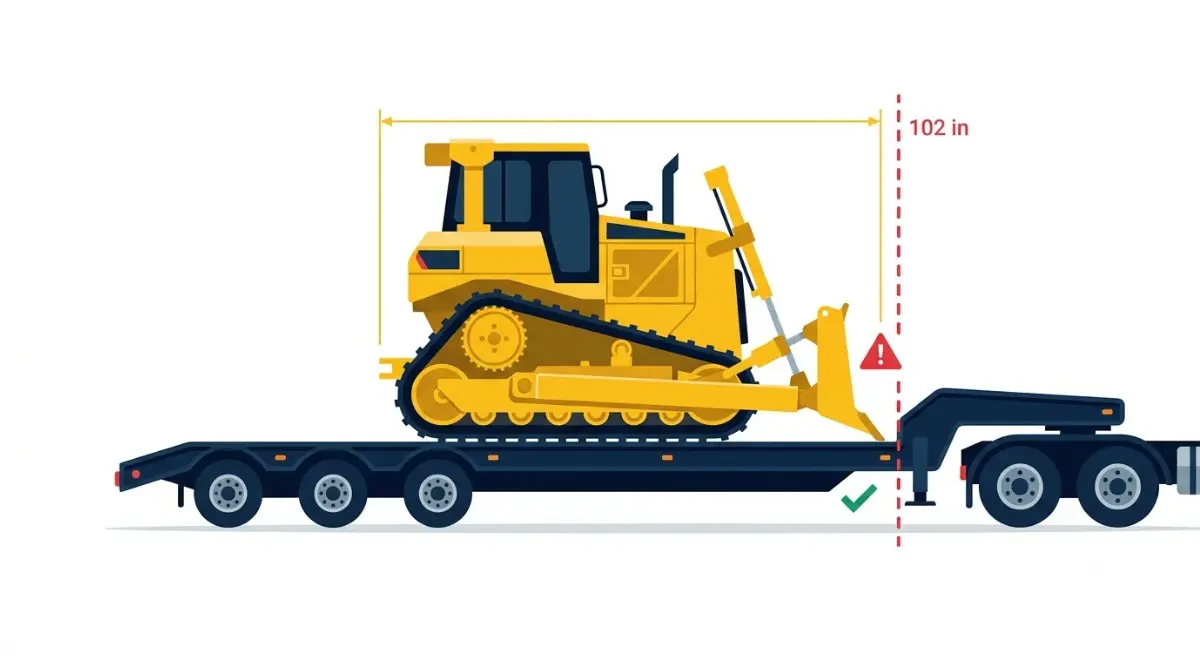
Table of Contents
Does your Deere dozer need an oversize permit?
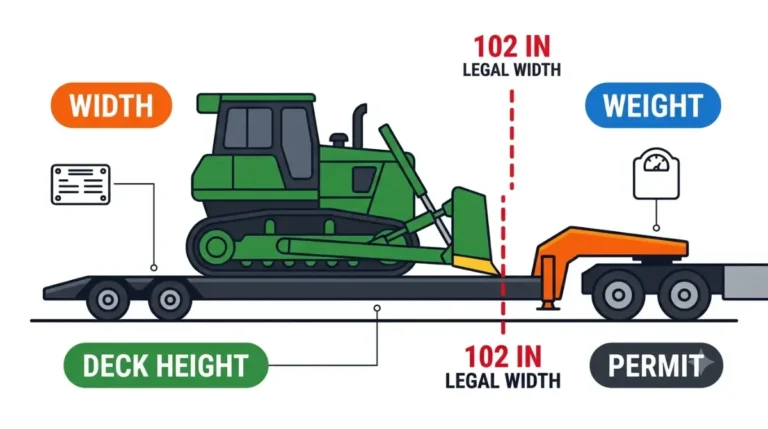
Yes, for almost every current model. With its blade straight, every current Deere crawler dozer from the 550 P-Tier up is wider than the federal legal width of 102 inches (8 ft 6 in), so it needs a width permit in every state it crosses. The standard 450 P-Tier, with a 97-inch blade, is the one exception. Height and weight then decide whether you need more than a width permit.
If you haul a 450 P-Tier
The standard 97-in blade is 5 inches under the line; the optional 124-in blade is 22 inches over. Check which one is fitted.
If you haul a 550 P-Tier or larger
Plan on a permit, then use the height, state, blade and weight sections below to see what else it needs.
ℹ️ Safety Note: A permitted dozer moves at the exact dimensions written on its permit. A blade that shifts, swings out or rides higher than permitted can strike traffic, bridges or overhead lines, and an under-secured machine can come off the trailer. Loading, blade positioning and securement follow the Deere operator’s manual and the federal cargo-securement rules in 49 CFR Part 393, carried out by a licensed carrier.
How far over 8 ft 6 in each Deere dozer sits
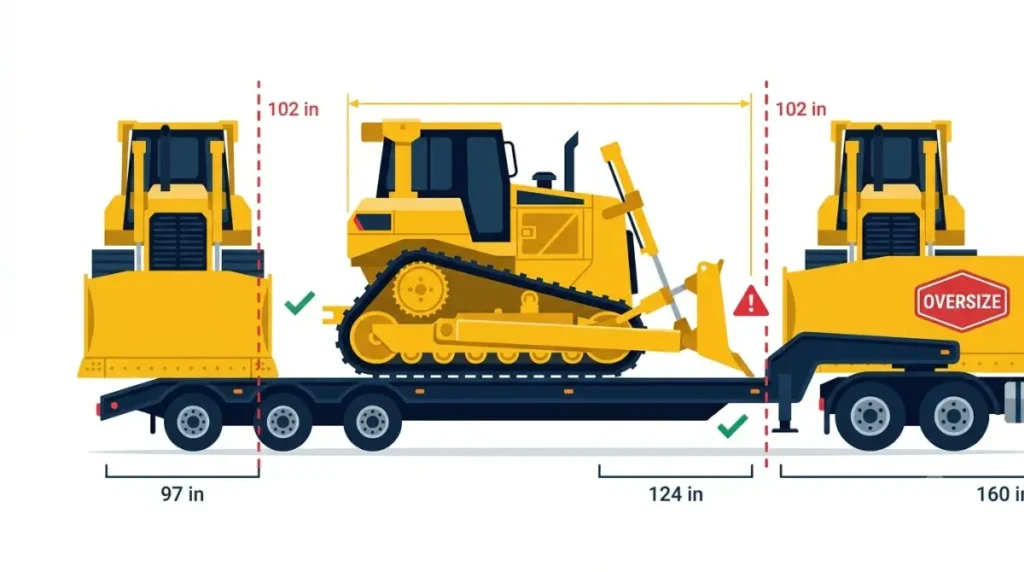
The blade is the widest point on a Deere dozer, and Deere publishes it straight, not angled.
| Model | Applies To | Blade width, straight | vs. 102 in |
|---|---|---|---|
| 450 P-Tier | Standard track, PAT blade | 97 in (2,464 mm) | 5 in under |
| 450 P-Tier | 124-in blade option | 124 in | 22 in over |
| 550 P-Tier | Standard, PAT | 105 in (2,667 mm) | 3 in over |
| 650 P-Tier | Standard, PAT | 115 in (2,921 mm) | 13 in over |
| 700 P-Tier | As listed by Deere (configuration not stated) | 133 in (3,383 mm) | 31 in over |
| 750 P-Tier | XLT, PAT | 130 in (3,296 mm) | 28 in over |
| 750 P-Tier | OSD blade | 129 in (3,265 mm) | 27 in over |
| 750 P-Tier | LGP, PAT | 156 in (3,962 mm) | 54 in over |
| 850 P-Tier | As listed, PAT | 168 in (4,267 mm) | 66 in over |
| 850 X-Tier | As listed | 168 in (4,267 mm) | 66 in over |
| 950 P-Tier | OSD semi-U | 154 in (3,911 mm) | 52 in over |
| 950 P-Tier | PAT (LGP track only) | 184 in | 82 in over |
| 1050 P-Tier | Semi-U, standard end bits | 167 in (4,242 mm) | 65 in over |
| 1050 P-Tier | U blade | 161 in (4,087 mm) | 59 in over |
Sources, verified 2026-10-16: Deere spec pages for the 450 P-Tier, 550 P-Tier, 650 P-Tier, 700 P-Tier, 850 P-Tier, 850 X-Tier and 950 P-Tier; Deere brochures MD450PAU, MD750PAU, MD950PAU and MD1050PAU. PAT = power-angle-tilt; OSD = outside dozer blade; LGP = low ground pressure; XLT = extra-long track.
📜 The Rule: No state may set a width limit above or below 102 inches for vehicles on the National Network (the Interstates and designated federal-aid highways); Hawaii keeps 108 inches, and states may issue special permits for wider vehicles. Source: the federal 102-inch width rule, 23 CFR 658.15, verified 2026-10-16. Regulations change — confirm the current text before each move.
For track gauge, shoe widths and every blade option, see the full Deere dozer specs by configuration.
Blade straight vs blade angled
Deere’s spec pages list blade width straight only; none of the pages checked publish an angled transport width. Some states require the blade angled to cut width (see the blade-rules section below). Measure the angled width on your machine, or get it from your dealer.
Configurations that change the answer
On the 750 P-Tier LGP (118 in) and the 1050 P-Tier (114 in), the width over the tracks alone is already past 102 inches. Taking the blade off does not make those machines legal-width. Deere’s MD750PAU brochure also lists an optional 161-in PAT blade.
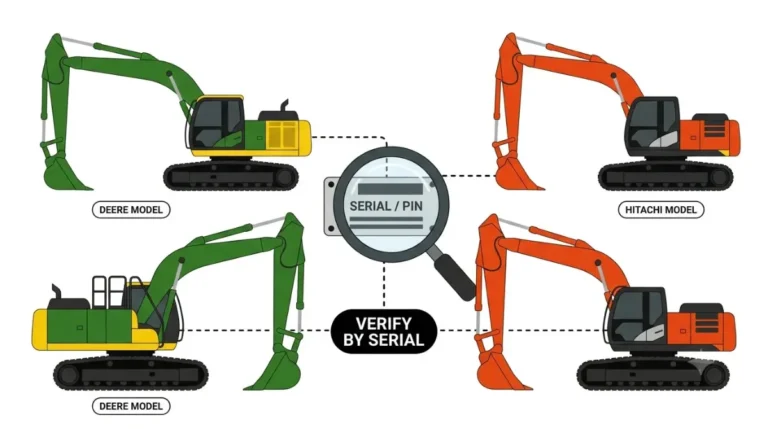
✅ Do This: Give your Deere dealer the machine’s serial number and ask two things: which blade is fitted, and the overall width with that blade fully angled.
Will your trailer push a Deere dozer over legal height?
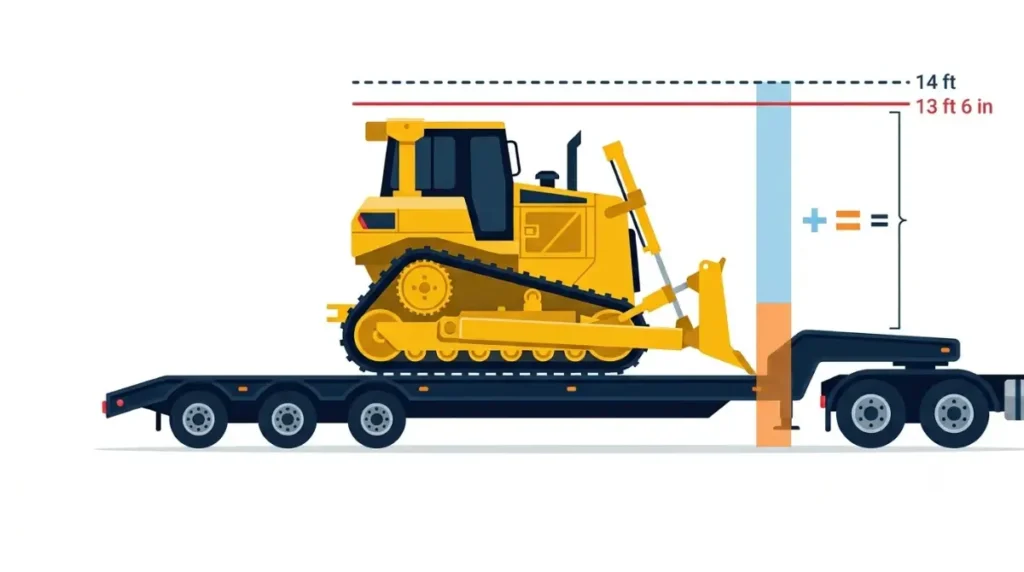
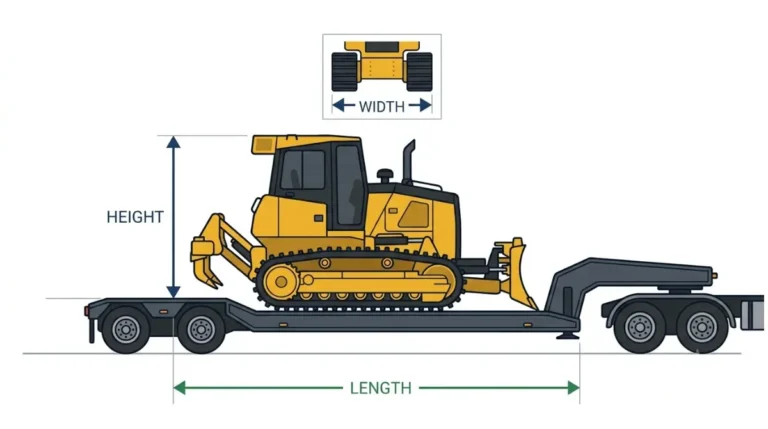
Loaded height is the machine’s height plus the deck height of the trailer it sits on. Subtract the machine from your state’s limit and you get the highest deck that keeps the load legal.
| Model | Applies To | Deere height | Max deck, 13 ft 6 in state | Max deck, 14 ft 0 in state |
|---|---|---|---|---|
| 450 / 550 / 650 P-Tier | Height – Max as listed | 114.1 in (2,899 mm) | 47.9 in | 53.9 in |
| 700 P-Tier | Height – Max as listed | 123.5 in (3,138 mm) | 38.5 in | 44.5 in |
| 750 P-Tier | To roof, incl. antenna base | 127.9 in (3,248 mm) | 34.1 in | 40.1 in |
| 750 P-Tier | With limb risers | 131.6 in (3,343 mm) | 30.4 in | 36.4 in |
| 850 P-Tier / 850 X-Tier | Height – Max as listed | 135.4 in (3,438 mm) | 26.6 in | 32.6 in |
| 950 P-Tier | Height – Max as listed | 134.9 in (3,427 mm) | 27.1 in | 33.1 in |
| 1050 P-Tier | To roof, incl. antenna base | 141.3 in (3,589 mm) | 20.7 in | 26.7 in |
Machine heights from the Deere spec pages and brochures cited in the width table, verified 2026-10-16. Max deck = state legal height (162 in or 168 in) minus Deere height.
The formula: machine height + deck height = loaded height
Take the 850 P-Tier in a 13 ft 6 in state: 162 in − 135.4 in = 26.6 in. Any deck higher than 26.6 inches under the tracks makes the load over-height, and that means a height permit on top of the width permit. Before you book, see what it takes to haul an 850 legally.
What adds height Deere’s figure doesn’t include
Aftermarket GNSS masts, beacons, cab-top lights and a blade carried raised all add height. Use the millimetre figures above: Deere prints 3,343 mm as “11 ft 6 in” (it is 10 ft 11.6 in) and 3,589 mm as “11 ft 5 in” (it is 11 ft 9.3 in).
🧮 Run the Numbers: Run your machine, blade and deck height through the permit checker. Have ready: model, blade fitted, measured deck height, and the states on your route.
⚠️ Hazard: An over-height load that meets a low bridge or overhead line can tear the machine off the trailer or bring the line down. Measure the loaded machine on the trailer, top of cab included, before the permit application — and have the licensed carrier confirm the deck height at the point where the tracks sit.
Legal height and width by state for a dozer load
Width is set federally; legal height is set by each state, and the nine states checked split between 13 ft 6 in and 14 ft 0 in.
| State | Legal height | Width | Official source (verified 2026-10-16) |
|---|---|---|---|
| Florida | 13 ft 6 in | 102 in; 96 in on travel lanes under 12 ft | Florida Highway Patrol size and permit enforcement |
| Georgia | 13 ft 6 in | 8 ft 6 in | Georgia DPS permit guidelines |
| Ohio | 13 ft 6 in | 102 in | Ohio Rev. Code § 5577.05 |
| Pennsylvania | 13 ft 6 in | 8 ft 6 in (National Network) | PennDOT, May 2023 |
| California | 14 ft 0 in | 8 ft 6 in | Caltrans’s 14-foot legal height |
| New Mexico | 14 ft 0 in | 8 ft 6 in (National Network) | 18.19.8.36 NMAC |
| Oregon | 14 ft 0 in | 8 ft 6 in | ODOT legal vehicle dimensions |
| Texas | 14 ft 0 in | 8 ft 6 in | Texas Transp. Code § 621.207 (Texas DPS) |
| Utah | 14 ft 0 in | 8 ft 6 in | Utah Admin. Code R909-2-4 |
Regulatory currency note: state limits change by statute and rule; these were read on 2026-10-16.
What is federal and what is not
The 102-inch width applies on the National Network. There is no federal height limit; the FHWA notes most state limits run 13 ft 6 in to 14 ft.
You need a permit from every state you cross
Each state issues permits for its own roads, so a Georgia-to-Texas move needs a Georgia permit, a Texas permit and one for every state between.
🗺️ State Check: Federal baseline: 102 in wide on the National Network, no federal height. Range in the states checked: 13 ft 6 in (FL, GA, OH, PA) to 14 ft 0 in (CA, NM, OR, TX, UT). For any other state, look up your state’s legal height and permit office and note its height limit and any lower limit on roads off the National Network.
✅ Do This: Ask the permit office or a licensed permit service to confirm height and width for your exact route — legal height does not clear a posted low bridge.
State rules for the dozer blade: angle it, guard it or pull it
Some states write rules for the dozer blade itself, and they decide whether it stays on, gets angled or rides separately.
| State | Blade rule | Current Deere blades affected | Citation (verified 2026-10-16) |
|---|---|---|---|
| Pennsylvania | Over 12 ft up to 15 ft: fit a traffic-protector guiderail device or angle the load to 12 ft. Over 15 ft: remove and haul separately. | 750 LGP, 850 P/X, 950 OSD, 1050: guard or angle. 950 PAT (15 ft 4 in): remove. | Pennsylvania’s dozer-blade rule, 75 Pa.C.S. § 4962(f.7) |
| Utah | Over 16 ft: remove; may ride on the same load. | None in the width table. | Utah Admin. Code R909-2-17(3) |
| New Mexico | Lower the blade fully, angle it as much as possible, secure it. | Every model over 102 in. | 18.19.8.35(B) NMAC |
| Texas | A detached blade may ride on the same trailer under a single-trip permit if the dozer alone is still overweight. | 1050 P-Tier (94,000 lb or more). | 43 Tex. Admin. Code § 219.2 |
Sources: the Pennsylvania statute linked above; Utah R909-2 as published by UDOT; New Mexico Title 18, Chapter 19, Part 8 NMAC; TxDMV Chapter 219 rules adopted 2024. Rules change — confirm the current text before each move.
The federal nondivisible-load test
Permits generally cover loads that can’t reasonably be broken down. Under the federal nondivisible-load definition, a load qualifies if splitting it would compromise its use, destroy its value, or take more than 8 workhours to dismantle — and the applicant must prove the hours. Whether your blade counts is the permit office’s call, not yours.
Escort triggers
New Mexico requires escort vehicles for any load 14 ft wide or wider (18.19.8.81 NMAC). Utah requires a police escort above 17 ft wide on secondary highways or 20 ft on freeways (UDOT oversize non-divisible load provisions). For other states, use the state lookup linked above.
⚠️ Hazard: A dozer blade is heavy, hydraulically held, and can drop or swing when pins or cylinders are disconnected. Blade removal or refitting is work for the dealer or a certified heavy equipment technician following the Deere manual — not a roadside job.
✅ Do This: Before you split blade and machine, ask the state permit office whether the detached blade may ride on the same trailer under your permit, and get the answer written on the permit.
When a Deere dozer also needs an overweight permit
The machine’s operating weight comes out of the same 80,000 lb gross limit as the tractor and trailer hauling it.
| Model | Applies To | Max operating weight | Share of 80,000 lb |
|---|---|---|---|
| 450 P-Tier | Heaviest listed configuration | 19,035 lb | 23.8% |
| 550 P-Tier | Heaviest listed configuration | 20,115 lb | 25.1% |
| 650 P-Tier | Heaviest listed configuration | 22,484 lb | 28.1% |
| 700 P-Tier | Heaviest listed configuration | 32,088 lb | 40.1% |
| 750 P-Tier | Heaviest listed configuration | 40,040 lb | 50.1% |
| 850 P-Tier | Heaviest listed configuration | 51,365 lb | 64.2% |
| 850 X-Tier | Heaviest listed configuration | 51,765 lb | 64.7% |
| 950 P-Tier | Heaviest listed configuration | 73,700 lb | 92.1% |
| 1050 P-Tier | Semi-U / U blade | 94,000 / 94,580 lb | 117.5% / 118.2% |
Weights from the Deere spec pages and MD1050PAU brochure cited in the width table, verified 2026-10-16. Share = machine weight ÷ 80,000 lb.
Federal weight limits
📜 The Rule: On the Interstate, gross weight is capped at 80,000 lb, a single axle at 20,000 lb and a tandem at 34,000 lb, with the Bridge Formula applied to axle groups; states may permit nondivisible loads above these. Source: federal axle and gross weight limits, 23 CFR 658.17, verified 2026-10-16.
Share of 80,000 lb used by the machine alone
A 950 P-Tier at 73,700 lb leaves 6,300 lb for the entire tractor and trailer. A 1050 P-Tier is over 80,000 lb before it is loaded on anything. For the smaller machines, the answer turns on the tare weight of your actual rig and how the load sits on its axles.
For every configuration weight, see Deere dozer weights by model.
✅ Do This: Ask the carrier for scaled axle weights of the loaded rig. Federal limits apply to each axle and axle group as well as the gross, so the gross figure alone does not tell you whether you need an overweight permit.
What to have ready before you apply
A permit application asks for the load as it will travel, so measure it on the trailer.
Numbers the application asks for
- Loaded height and loaded width, in feet and inches, measured on the trailer (Caltrans asks for both)
- Axle widths for weight applications (Caltrans) and scaled axle weights from the carrier
- Which blade is fitted and its fully angled width
- The route, state by state
Identity checks some states run
Texas checks your USDOT number against FMCSA’s records for out-of-service orders before it issues a permit. If you are not required to have a USDOT number, TxDMV requires a $10,000 permit surety bond on file (TxDMV time permits, verified 2026-10-16).
Signs, flags and lights
Sign, flag and light requirements are set state by state; follow what your permit specifies.
✅ Do This: A licensed permit service or your carrier can file multi-state permits in one request.
Frequently asked questions
1. What is the legal width for hauling a dozer?
The legal width for a dozer load is 102 inches (8 ft 6 in) on the National Network, under 23 CFR 658.15.
2. Does the blade count toward dozer load width?
Yes. The blade is the widest point on a Deere dozer, so blade width decides whether the load needs an oversize permit.
3. Can a Deere 450 P-Tier be hauled without an oversize permit?
On width, yes with the standard 97-inch blade — 5 inches under 102 inches. The optional 124-inch blade needs a permit. Confirm the fitted blade with your dealer.
4. Does a Deere 550 P-Tier need an oversize permit?
Yes, for width. Its standard 105-inch blade is 3 inches over the 102-inch legal width, before height or weight are considered.
5. How low must the trailer deck be for a Deere 850 dozer?
At most 26.6 inches in a 13 ft 6 in state and 32.6 inches in a 14 ft state, using Deere’s 135.4-inch height. Measure the loaded height before you apply.
6. What is the legal load height in California?
California’s legal height is 14 ft 0 in, per Caltrans; a dozer load taller than that needs an oversize permit for height.
7. Do I need an oversize permit in every state I drive through?
Yes. Each state issues permits for its own roads, so an oversize dozer load needs a permit from every state on the route.
8. Do I have to take the dozer blade off in Pennsylvania?
Only if it is over 15 feet wide. A 12–15 ft blade may stay on with a guiderail device or angled to 12 feet.
9. Can a removed dozer blade ride on the same trailer?
In Utah, yes — blades over 16 ft must come off but may ride along. Texas allows it when the dozer is still overweight. Get it written on your permit.
10. Is a Deere 1050 P-Tier always an overweight load?
Yes. At 94,000 lb or more on its own, it exceeds the 80,000 lb federal gross limit before any tractor or trailer. Get scaled axle weights for the permit.
Before you book the move
From the 550 P-Tier up, the permit is a given; the work is getting the numbers right. Next, see what it takes to haul an 850 legally, run your model, blade, deck height and route through the permit checker, and keep the Deere dozer specs by configuration at hand.
Have your licensed carrier or permit service confirm the angled blade width and loaded height for your route. Figures come from Deere and the official texts below, verified 2026-10-16.
Sources
- Federal: 23 CFR 658.5, 23 CFR 658.15, 23 CFR 658.17, FHWA Federal Size Regulations for Commercial Motor Vehicles
- States: Caltrans, Florida Highway Patrol, Georgia DPS, Ohio Rev. Code § 5577.05, PennDOT, 75 Pa.C.S. § 4962, 18.19.8 NMAC, ODOT, Texas DPS, TxDMV Chapter 219 rules, TxDMV time permits, Utah R909-2, UDOT oversize non-divisible load provisions
- Deere: spec pages and brochures linked under the width table