John Deere Wheel Loader Models, Sourced to Deere by Bucket Size

John Deere wheel loader models span 0.9 to 10.25 cu yd, with Deere’s conflicting figures logged and widths checked against the federal 102 in.
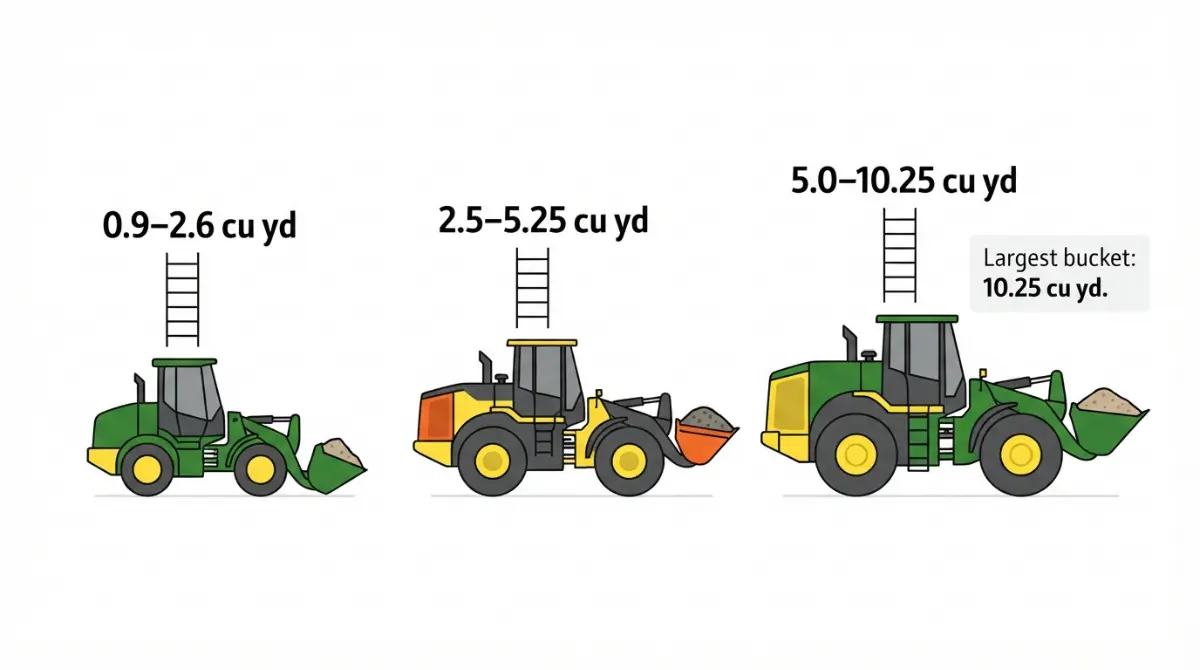
Table of Contents
John Deere wheel loader bucket sizes, 244 through 944
John Deere wheel loader models list bucket capacities from 0.9–1.4 cu yd (0.7–1.1 m³) on the 304 G to 9.80–10.25 cu yd (7.5–7.8 m³) on the 904 X. Compact models run 0.9–2.6, mid-size 2.5–5.25 and large 5.0–10.25. The biggest bucket is not on the biggest machine: the 944 X lists 8.5–10.0. Ranges are Deere’s published figures for each model, checked 2026-10-09.
Bucket range by class
| Class | Models | Bucket capacity range, cu yd (m³) | Applies To |
|---|---|---|---|
| Compact | 244 P, 304 G, 324 P, 326 P, 344 P | 0.9–2.6 (0.7–2.0) | Deere’s published range, all bucket options |
| Mid-size | 524 P, 544 P, 624 P, 644 P, 644 X, 724 P | 2.5–5.25 (1.9–4.0) | Deere’s published range, all bucket options |
| Large | 744 P/X, 824 P/X, 844 P/X, 904 P/X, 944 X | 5.0–10.25 (3.8–7.8) | Deere’s published range, all bucket options |
Source: Deere product pages, retrieved 2026-10-09; m³ as Deere lists it or converted by us. Operating weights in later tables are Deere’s published ranges; Deere does not define the term.
Which section to read first
Choosing a size: Sections 2 to 5. Hauling one: Section 6. Other Deere equipment: Deere’s full construction equipment spec compilation. Left out: the 444 P (its Deere page would not open) and tractor-mounted loaders.
ℹ️ Safety note. Moving a loader on a trailer risks load shift or loss of load. Working a loader above its rated operating capacity risks tip-over. This article gives specifications and general context only, not procedures; follow the operator’s manual and a qualified carrier.
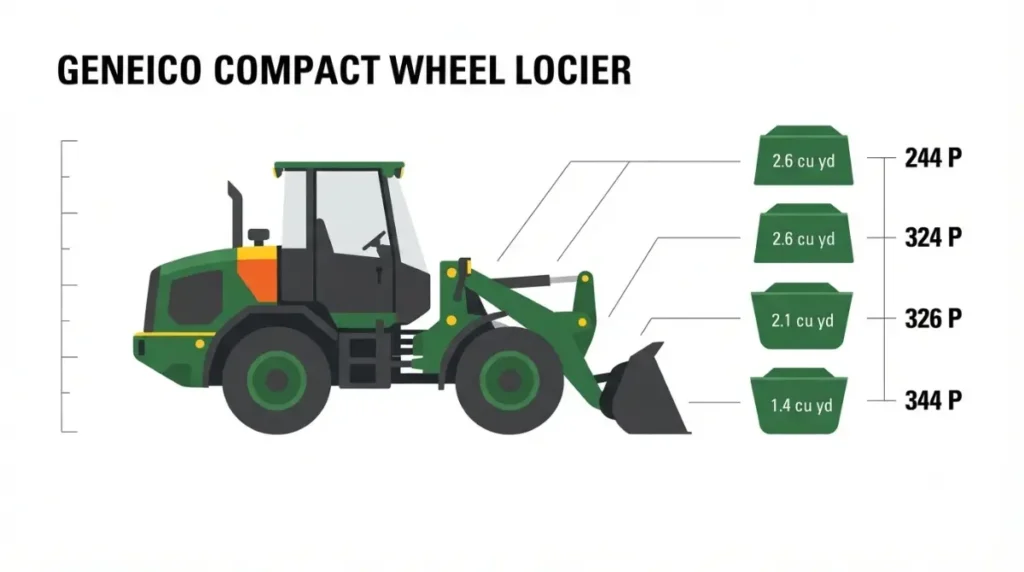
Compact: 244 P, 304 G, 324 P, 326 P and 344 P bucket sizes
| Model | Net hp | Operating weight, lb | Bucket capacity range, cu yd (m³) | Applies To |
|---|---|---|---|---|
| 244 P | 71 | 12,258 | 1.0–1.4 (0.8–1.1) | Deere range as published; options not itemized |
| 304 G | 72 | 13,051 (page header); 12,941 (spec table) | 0.9–1.4 (0.7–1.1); heaped 1.0 | Deere range as published; options not itemized |
| 324 P | 71 | 14,110 | 1.0–2.1 (0.8–1.6); standard bucket heaped 1.4 | Deere range as published; options not itemized |
| 326 P | 71 | 14,110 | 1.0–2.6 (0.8–2.0); heaped 1.4 | Deere range as published; options not itemized |
| 344 P | 103 | 19,533 | 2.0–2.6 (1.5–2.0) | Deere range as published; options not itemized |
Source: Deere product pages (deere.ca), retrieved 2026-10-09.
244 P, 304 G, 324 P and 326 P: small frames, different tops
These four weigh 12,258–14,110 lb. Their compact wheel loader bucket size tops differ: 1.4 cu yd (244 P), 2.1 (324 P) and 2.6 (326 P). The 326 P matches the 324 P in weight and engine, with the wider range.
344 P: the largest compact
The 344 P adds power (103 hp) and weight (19,533 lb). Its 2.0–2.6 cu yd overlaps the 326 P’s top, so it is a bigger machine, not a bigger bucket.
Mid-size: 524 P through 724 P, including the 644 X
| Model | Net hp | Operating weight, lb | Bucket capacity range, cu yd (m³) | Applies To |
|---|---|---|---|---|
| 524 P | 152 | 28,931–29,018 | 2.5–4.5 (1.9–3.4) | Headline range; spec table lists 2.75–3.25 for standard buckets |
| 544 P | 166 | 30,520–30,598 | 2.5–5.25 (1.9–4.0) | Deere range as published; options not itemized |
| 624 P | 192 | 34,715–34,810 | 2.5–5.25 (1.9–4.0) | Deere range as published; options not itemized |
| 644 P | 249 | 41,246–41,324 | 4.0–4.75 (3.1–3.6); heaped 4.25 | Deere range as published; options not itemized |
| 644 X | 231 | 41,571–41,649 | 4.0–4.75 (3.1–3.6) | Hybrid-electric powershift; range as published |
| 724 P | 268 | 43,707–43,783 | 4.0–5.0 (3.1–3.8) | Deere range as published; options not itemized |
Source: Deere product pages, retrieved 2026-10-09.
524 P, 544 P and 624 P: the same 2.5-yard floor, different tops
All three start at 2.5 cu yd. The tops are 4.5 (524 P) and 5.25 (544 P, 624 P). The 524 P’s spec table lists 2.75–3.25 for standard buckets, so its headline range spans linkage options.
644 P vs 644 X: same bucket, different drive
Both list 4.0–4.75 cu yd. The 644 P makes 249 hp; the 644 X makes 231 hp with a hybrid-electric drive.
📋 Verified Spec — 644 P: 4.0–4.75 cu yd (3.1–3.6 m³); standard-bucket heaped capacity 4.25 cu yd. Source: Deere 644 P product page, 2026-10-09.
724 P: the top of the mid-size class
At 4.0–5.0 cu yd, the 724 P tops out below the 544 P’s 5.25 yet weighs over 13,000 lb more.
Large: 744 to 944, and where Deere’s own figures split
| Model | Net hp | Operating weight, lb | Bucket capacity range, cu yd (m³) | Applies To |
|---|---|---|---|---|
| 744 P | 316 | 54,920–58,709 | 5.0–5.85 (3.8–4.5) | Deere range as published |
| 744 X | 325 (net peak) | 56,524–59,267 | 5.0–5.85 (3.8–4.5) | Deere’s English-language page; EU distributor differs |
| 824 P | 343 | 58,334–61,952 | 5.0–6.75 (3.8–5.2) | Deere range as published |
| 824 X | 343 net | 59,994–62,840 | 5.25–7.0 (4.0–5.4) | Deere range as published |
| 844 P, Set A | 417 | 74,831–76,670 | 6.3–8.0 (4.8–6.1) | deere.com/en page; PowerTech PSS 6135 engine |
| 844 P, Set B | 417 | 71,516–74,629 | 6.3–8.0 (4.8–6.1) | deere.ca page; JD14 engine |
| 844 X | 422 (peak) | 72,713–75,067 | 6.3–8.5 (4.8–6.5) | Launched 2026-05-21; range as published |
| 904 P, Set A | 429 | 80,050–80,318 | 9.3–9.8 (7.1–7.5) | deere.com/en page; PowerTech PSS 6135 engine |
| 904 P, Set B | 429 | 77,900–78,765 | 9.3–9.8 (7.1–7.5) | deere.ca page; JD14 engine |
| 904 X | 442 | 80,063–80,321 | 9.80–10.25 (7.5–7.8); heaped 9.8 | Electric Variable Transmission (EVT); JD14 engine |
| 944 X | 536 | 119,607–124,614 | 8.5–10.0 (6.5–7.65) | AC electric drive; range as published |
Source: Deere product pages, retrieved 2026-10-09.
🔍 Where Deere’s own pages disagree (found 2026-10-09)
| Item | One Deere source says | Another says | Applies To |
|---|---|---|---|
| 844 P weight | 74,831–76,670 lb (deere.com/en) | 71,516–74,629 lb (deere.ca) | Engine split: PSS 6135 vs JD14 |
| 904 P weight | 80,050–80,318 lb (deere.com/en) | 77,900–78,765 lb (deere.ca) | Engine split: PSS 6135 vs JD14 |
| 544 P upper weight | 32,598 lb (mid-size listing page) | 30,598 lb (model page; its kg figure matches) | Listing typo likely |
| 724 P power | 264 hp (mid-size hub text) | 268 hp (model page) | Net hp |
| 744 X | 5.0–5.85 cu yd, 56,524–59,267 lb (English page) | 3.5–4.6 m³, 26,798 kg (Deere EU distributor) | Regional difference |
| 824 X power | 354 hp (page headline, net peak) | 343 hp (spec table, net) | Labelled differently |
| 304 G weight | 13,051 lb (page header) | 12,941 lb (spec table) | Same page |
| 904 X vs 904 P width | 3290 mm (904 X page) | 3408 mm (904 P page) | Tire fitted not stated |
744 and 824: P-Tier vs X-Tier ranges
The 744 P and 744 X both list 5.0–5.85 cu yd. On the 824, the X lists 5.25–7.0 against the P’s 5.0–6.75.
844 and 904: two Deere-published weight sets
The deere.com/en pages pair a PowerTech PSS 6135 engine with the higher weights; the deere.ca pages pair a JD14 engine with the lower ones. The pages do not say when the change took effect, so both sets are shown.
If your serial number falls near the transition, ask your dealer for the engine model and the weight on that machine’s spec sheet.
944 X: the largest machine, not the largest bucket
The 944 X lists 8.5–10.0 cu yd at 119,607–124,614 lb. The 904 P’s 9.3–9.8 cu yd sits inside that range on a machine more than 39,000 lb lighter. The 904 X lists the largest bucket, up to 10.25.
What bucket capacity actually means on the jobsite
Heaped vs struck: what Deere’s table is rating

A wheel loader bucket capacity is struck when material sits level with the bucket edge and heaped when it piles above it. Deere lists a range and, on some models, a separate heaped figure for the standard bucket. Its pages do not say whether the range is heaped or struck.
📜 The standard. ISO 7546 gives a consistent way to compare loader buckets; it is not meant to define the capacity seen in a specific application. Source: ISO 7546 loader bucket volumetric ratings, abstract checked 2026-10-09.
Fill factor and material density
Fill factor (how full the bucket loads) and material density (weight per cubic yard) decide what a bucket carries. Rated operating capacity, covered by ISO 14397-1, is a separate figure that limits the load; ask your Deere dealer for it for your exact bucket and linkage.
Passes to fill a truck: the formula
🧮 Run the Numbers. Passes = truck payload (lb) ÷ (bucket cu yd × fill factor × material density in lb per cu yd), rounded up. No density or payload is published here because none was sourced.
⚠️ Hazard. A formula does not set a safe load; the operator’s manual and a Deere dealer do.
Which Deere loaders are wider than the 102-inch limit
The federal 102-inch baseline
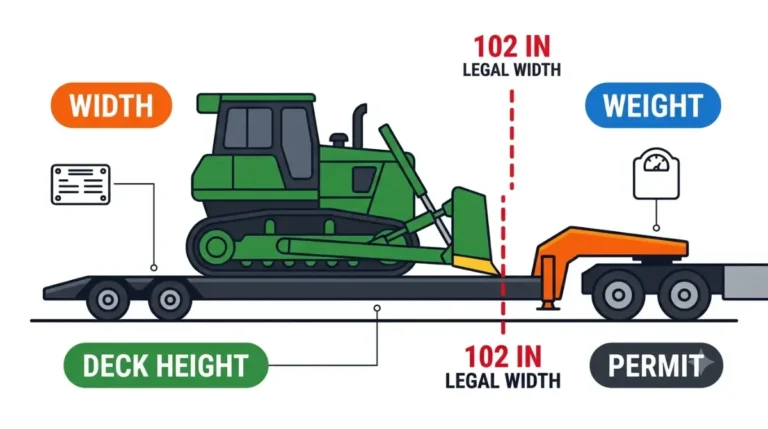
📜 The rule. Under 23 CFR 658.15, a State may not set a width limit above or below 102 in on the National Network, and may grant special use permits above it. Source: federal 102-inch width rule, eCFR current as of 2026-10-06, checked 2026-10-09.
The same rule applies to the dozer in John Deere 700L weight for XLT and LGP.
Width over standard tires, model by model
| Model | Width over standard tires, in (mm) | Difference from 102 in | Applies To |
|---|---|---|---|
| 244 P | 75.6 (1920) | −26.4 | Standard tires only |
| 304 G | 77.2 (1960) | −24.8 | Standard tires only |
| 324 P / 326 P | 82.3 (2090) | −19.7 | Standard tires only |
| 344 P | 93.3 (2370) | −8.7 | Standard tires only |
| 524 P / 544 P | 100.2 (2546) | −1.8 | Standard tires only |
| 624 P | 104.6 (2657) | +2.6 | Standard tires only |
| 644 P / 644 X | 113.2 (2875) | +11.2 | Standard tires only |
| 724 P | 113.4 (2880) | +11.4 | Standard tires only |
| 744 P/X, 824 P/X | 121.4 (3084) | +19.4 | Standard tires only |
| 904 X | 129.5 (3290) | +27.5 | Standard tires only |
| 844 P/X, 904 P | 134.2 (3408) | +32.2 | Standard tires only |
| 944 X | 146.8 (3729) | +44.8 | Standard tires only |
Source: Deere width figures, retrieved 2026-10-09; inches = mm ÷ 25.4. Example: 2875 ÷ 25.4 = 113.2 in; 113.2 − 102 = 11.2 in over. The 444 P is omitted.
The table shows the machine on standard tires. Trailer, tire option and route decide the real answer, and a width under 102 in does not settle the permit question.
⚠️ Hazard. Do not remove tires, buckets or parts to get under a width or weight line; loading and securement belong to a qualified carrier.
Weight: operating weight is not shipping weight
Deere does not define operating weight on its model pages, so treat it as a published range, not a shipping weight.
The federal weight limits set 80,000 lb gross vehicle weight unless the bridge formula is lower, 20,000 lb per single axle and 34,000 lb per tandem. The 904 X and the higher 904 P weight set exceed 80,000 lb before the tractor and trailer.
How states handle overwidth permits
🗺️ State check. Each State sets permit rules above the federal baseline. Only California’s DOT page returned a usable figure on 2026-10-09.
| State | What the state page says | Source and date |
|---|---|---|
| California | Single-trip permits cover “loads greater than 8′-6″ wide, 14′-0″ high, and over 80,000 pounds”; annual and repetitive permits cover loads up to 12′-0″ wide; variance permits cover vehicles greater than 15′-0″ wide | Caltrans transportation permits, retrieved 2026-10-09; no update date on page |
| Texas | Permit page lists a house-move permit above 20 ft wide and refers to a separate size-and-weight page for the general limit. | TxDMV permit page, retrieved 2026-10-09 |
| Florida, Pennsylvania, Ohio | Not retrieved |
For your route, ask the state permit office at what width an overwidth permit starts and what escort or travel-time rules apply.
Picking a class: the truck, the trailer, the jobsite
Match the class to the truck you load
Start with the truck’s rated payload, then the bucket volume that fills it in an acceptable number of passes (formula in Section 5).
Check the trailer and width before you commit
Compact models, the 524 P and the 544 P are under 102 in on standard tires; the 624 P and larger are over (Section 6). The 904 class also lists 77,900–80,321 lb before the trailer.
✅ Do This. Decide in this order: the truck, then the trailer and width, then the machine.
John Deere wheel loader models: quick answers
1. What are the John Deere wheel loader models?
Compact: 244 P, 304 G, 324 P, 326 P, 344 P. Mid-size: 524 P–724 P and 644 X. Large: 744 P/X through 944 X.
2. What bucket size is on a 644 P?
Deere lists 4.0–4.75 cu yd (3.1–3.6 m³), with a standard-bucket heaped capacity of 4.25 cu yd.
3. What is the largest Deere wheel loader bucket?
The 904 X, at 9.80–10.25 cu yd (7.5–7.8 m³). The 944 X is heavier but lists 8.5–10.0 cu yd.
4. What is the smallest Deere wheel loader bucket in this range?
The 304 G, at 0.9–1.4 cu yd (0.7–1.1 m³). The 244 P lists 1.0–1.4 cu yd.
5. Does Deere list wheel loader bucket capacity as heaped?
Deere lists a heaped capacity for some standard buckets separately. Its pages do not say whether the capacity range is heaped or struck.
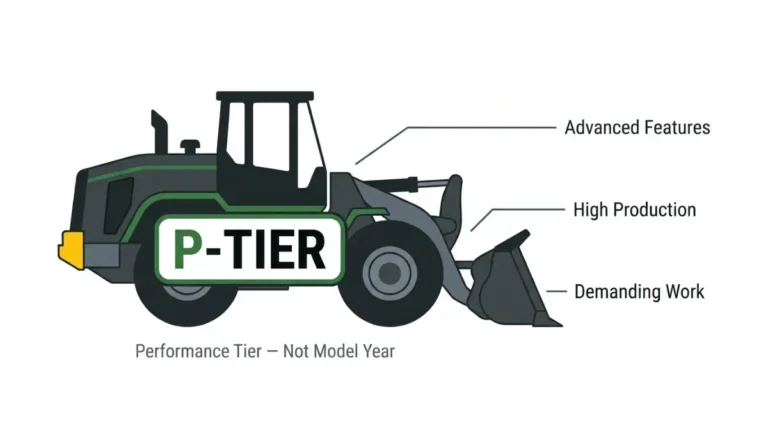
6. What do P-Tier and X-Tier mean on john deere wheel loader models?
X-Tier means electrified drive: hybrid-electric on the 644 X, EVT on the 744, 824, 844 and 904 X, AC electric on the 944 X.
7. Do P-Tier and X-Tier have the same bucket range?
Not always. The 744 P and 744 X both list 5.0–5.85 cu yd, but the 824 X lists 5.25–7.0 against the 824 P’s 5.0–6.75.
8. Which Deere loaders are wider than 102 inches?
On standard tires, the 624 P and every larger model. A width under 102 in does not settle permits; ask your state permit office and carrier.
9. How much does a 944 X weigh?
Deere lists an operating weight of 119,607–124,614 lb (54,253–56,524 kg), not a shipping weight; it does not define the term on model pages.
10. How many passes fill a truck?
Truck payload divided by bucket volume × fill factor × material density, rounded up. Section 5 gives the formula; no density or payload was sourced.
Conclusion
These tables give you a short list, not a decision. Whether you can haul it is Section 6: take the width, height and operating weight to the permit and dimension checker. For other equipment, see Deere’s full construction equipment spec compilation; for a Deere dozer’s width and weight, see John Deere 700L weight for XLT and LGP.
Hire out one thing: ask a licensed heavy-haul carrier or your state permit office for the permit threshold at your machine’s width and the weight on your trailer, and ask your Deere dealer for the rated operating capacity of your exact bucket and linkage.