Skid Steer Downtime Cost Per Hour, Full Line-by-Line Math

Skid steer downtime cost, priced line by line: owning cost, burdened operator wages, and why FEMA’s equipment rate can’t stand in for either.
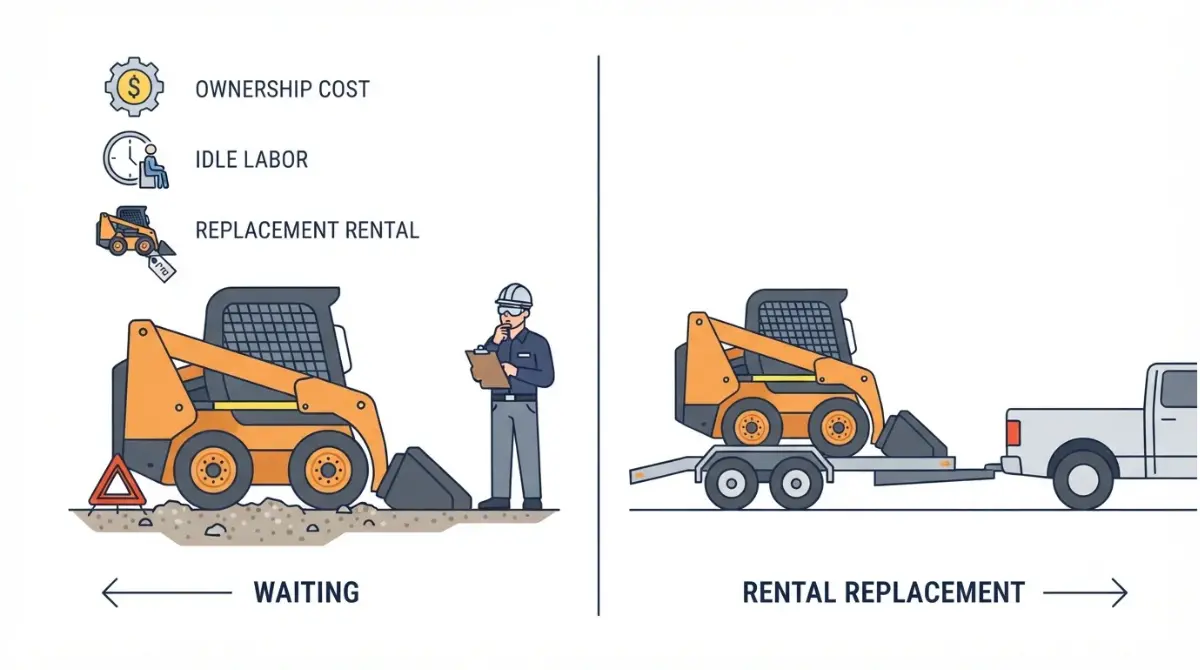
Table of Contents
Skid steer downtime cost per hour, answered
Downtime cost per hour is the owning cost of the idle machine plus the burdened wage of every crew member left standing around. If you rent a replacement, its hourly cost stands in for both. In the worked example below, that is $10.00 an hour with the crew reassigned, $45.98 with one operator idled, and $81.96 with two.
| Cost line | How to compute it | Worked in |
|---|---|---|
| Owning cost per hour | (Price − residual value) ÷ hours kept | Section 3 |
| Idle crew per hour | Hourly wage × (1 + burden) × people idled | Section 4 |
| Replacement rental per hour | Day or week rate ÷ billed hours | Section 6 |
Inputs are labeled “assumed” wherever they are not sourced.
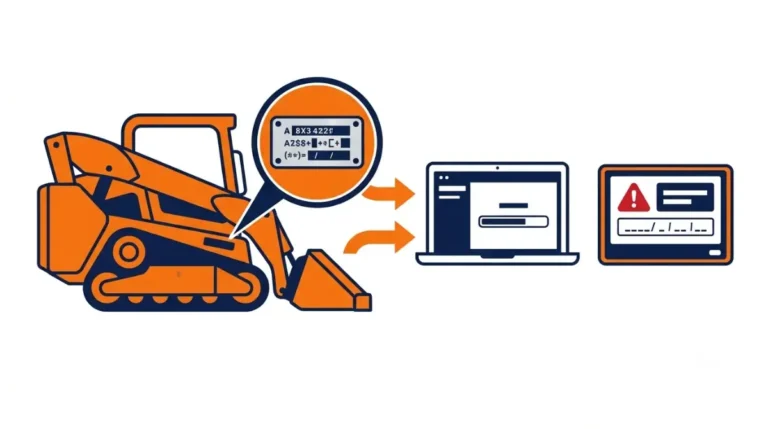
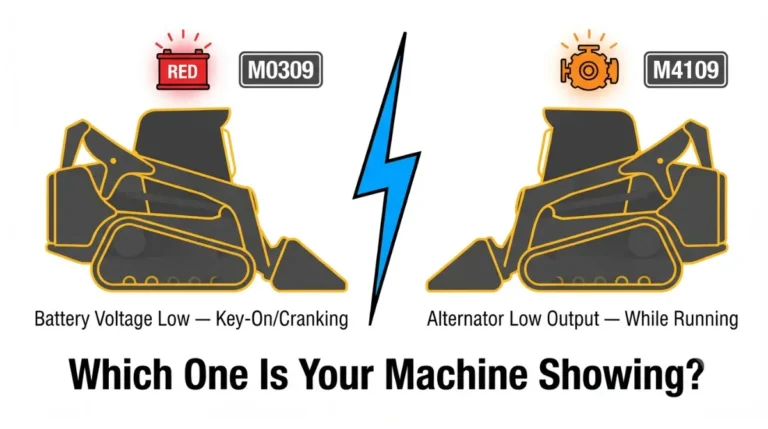
Not sure your code is a stop-work code? Start with which Bobcat fault codes actually stop work, then come back here.
ℹ️ Safety Note: Downtime cost is never a reason to keep working a machine that has shown a stop-work code, because running it risks injury and further damage. An authorized Bobcat dealer technician should read and clear the code.
What counts as downtime cost, and what doesn’t
Downtime cost covers the hours a machine earns nothing while some of its costs keep running.
Two ways trade press measures it
Mike Vorster, writing in Construction Equipment in 2018, gives the simplest method: a down machine cannot recover its owning cost, so downtime cost per hour equals owning cost per hour. His second method prices those hours at the hourly cost of a rented replacement. He describes two further approaches that add associated crews and machines, and calls them extremely difficult to quantify.
Treat the first two as alternatives and never add them together; that rule is this site’s editorial judgment, not Vorster’s. We add one line his simplest method omits: the wages of a paid crew left idle.
Costs that stop when the machine stops
Fuel and wear stop when the machine sits, so they stay out of the number. The repair invoice is its own line, not part of downtime cost.
Owning cost per hour of the machine sitting idle
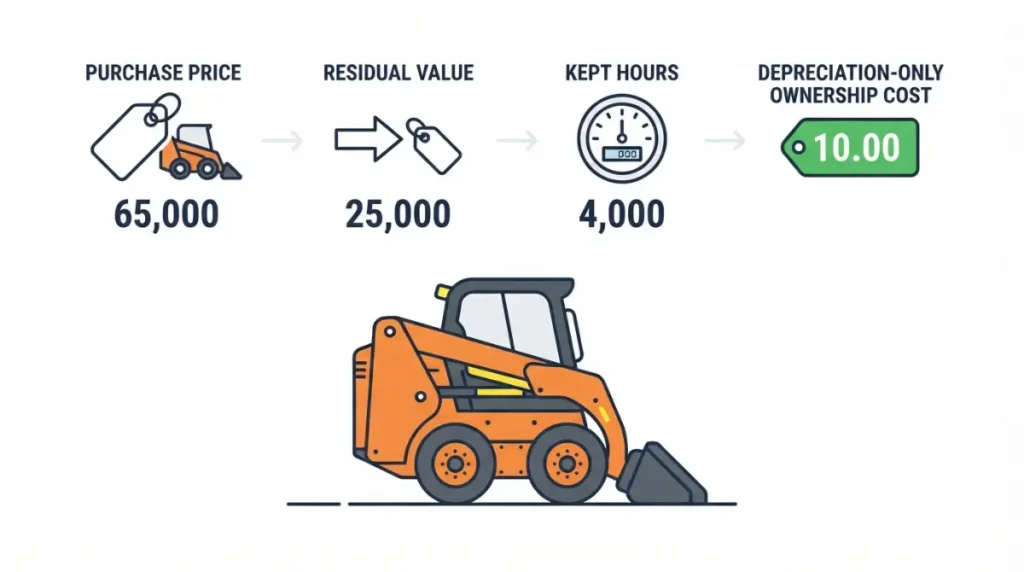
Owning cost accrues whether the machine runs or not; operating cost does not.
| Input | Value | Applies to |
|---|---|---|
| Purchase price | $65,000 (assumed) | Illustrative wheeled skid steer, S650 class |
| Residual value | $25,000 (assumed) | Same |
| Hours kept | 4,000 (assumed) | Same |
| Owning cost per hour | ($65,000 − $25,000) ÷ 4,000 = $10.00 | Same |
Assumed inputs, not market data. Method: net owning cost divided by hours kept, as Equipment World describes it (excerpt read October 6, 2026).
🧮 Run the Numbers: Swap in your own price, residual value and hours kept with the Equipment Cost-Per-Hour Calculator.
Why FEMA’s rate isn’t a downtime benchmark
FEMA’s 2025 Schedule of Equipment Rates lists skid steers at $31.06 an hour up to 24 hp, $45.23 up to 74 hp, and $60.67 up to 105 hp. Each rate bundles depreciation, maintenance, fuel and tires, leaves out operator labor, and does not reimburse standby, so it prices a machine working, not one sitting.
📜 The Rule: FEMA applies this schedule to applicant-owned equipment on eligible disaster work under 44 CFR § 206.228. It is not a contractor billing standard. Checked October 6, 2026 (eCFR current as of September 25, 2026).
Idle labor and the full hourly number
Idle labor is the wage you still pay people who have no machine to run.
Burdening the wage
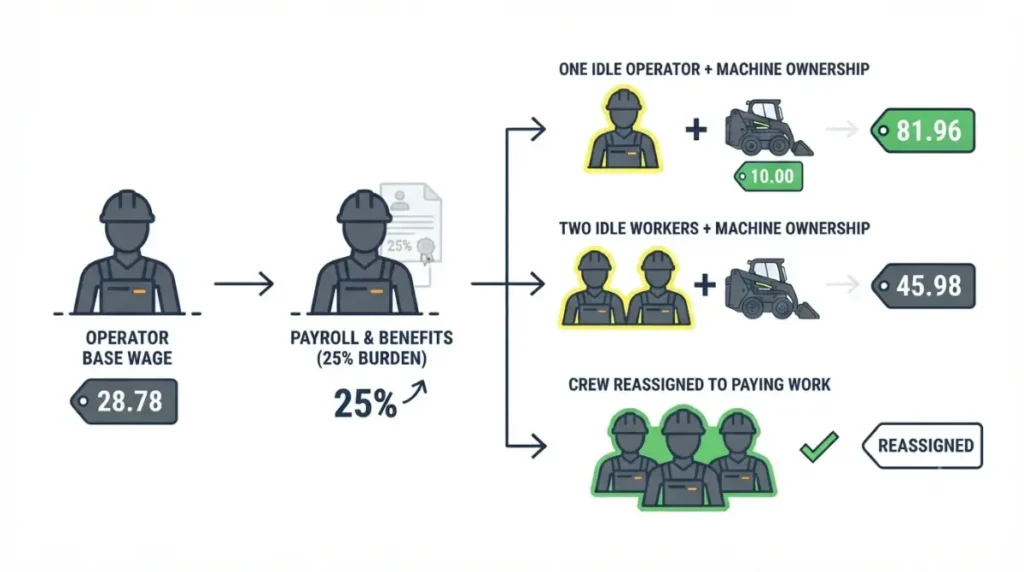
The Bureau of Labor Statistics reports a May 2025 national median of $28.78 an hour for operating engineers and other construction equipment operators (SOC 47-2073, all machine types). An assumed 25% labor burden for payroll taxes and benefits brings that to $35.98. Use your own burden.
Four scenarios, one table
| Scenario | Calculation | Cost per hour |
|---|---|---|
| A. One operator idled, no replacement | $10.00 + $35.98 | $45.98 |
| A. Two people idled, no replacement | $10.00 + 2 × $35.98 | $81.96 |
| B. Crew reassigned to paying work | $10.00 | $10.00 |
| C and D. Rented replacement, day or week | See Section 6 | See Section 6 |
Wage: BLS OEWS, May 2025, national median, SOC 47-2073, as republished by O*NET OnLine; verified October 6, 2026. Owning cost and burden are assumptions.
How operator wages change the number
The wage line moves the result more than any other input.
Wage spread inside one national estimate
| BLS percentile | Hourly wage | With 25% burden | One idled + $10.00 owning |
|---|---|---|---|
| 10th | $20.28 | $25.35 | $35.35 |
| 25th | $23.40 | $29.25 | $39.25 |
| Median | $28.78 | $35.98 | $45.98 |
| 75th | $37.10 | $46.38 | $56.38 |
| 90th | $48.60 | $60.75 | $70.75 |
BLS OEWS, May 2025, national, SOC 47-2073, as republished by O*NET OnLine; verified October 6, 2026. Burden and owning cost are assumed.
Find your metro
🗺️ State Check: BLS publishes this wage by state and metropolitan area in its May 2025 OEWS tables. Find Operating Engineers and Other Construction Equipment Operators (47-2073) for your area and put that hourly median where $28.78 sits in Section 4.
Rent a replacement or wait for the part?
A rental beats waiting only when its hourly cost undercuts what the idle machine and crew cost you.
Daily vs weekly replacement cost per hour
| Dealer and region | Class | Day / week rate | Per hour, day / week | Rate date |
|---|---|---|---|---|
| Bobcat of Omaha, Nebraska | S650/S66/S76 | $260 / $845 | $32.50 / $21.13 | Page updated Oct 5, 2026 |
| Atlas Bobcat, Chicago area | S650/S740 | $325 / $1,300 | $40.63 / $32.50 | Viewed Oct 6, 2026 (undated) |
| Lano Equipment, Norwood, Minnesota | 2025 S650 | $225 / $900 | $28.13 / $22.50 | Viewed Oct 6, 2026 (undated) |
Per-hour figures assume an 8-hour day and 40-hour week, the basis Bobcat of Omaha states; Atlas and Lano do not state theirs. Omaha’s rates exclude delivery, taxes, protection-plan fees and fuel. These are Scenarios C and D from Section 4.
When renting beats idling
At these inputs, every daily rate ($28.13 to $40.63 an hour) undercuts one idled operator plus owning cost ($45.98), so renting wins whenever the crew would otherwise stand idle. If the crew has paying work elsewhere (Scenario B, $10.00), waiting is cheaper than any rental. On Omaha’s rates, three daily rentals cost $780 and four cost $1,040, against $845 for a week, so the weekly rate wins from the fourth day.
⚠️ Hazard: Running a machine that has shown a stop-work code risks injury and further damage, whatever the rental math says. Return it to service only after an authorized Bobcat dealer technician has cleared it.
Run your own number and ask the dealer for an ETA
Hours down is the one input only the dealer can estimate.
The downtime worksheet
- Owning cost per hour: (price − residual value) ÷ hours kept.
- Idle labor per hour: wage × (1 + burden) × people idled.
- Hours down: the dealer’s written estimate.
- Add lines 1 and 2, multiply by line 3, then compare with the replacement rate × billed hours.
What to get in writing
✅ Do This: Ask the dealer for a parts ETA and labor-hours estimate in writing, and the rental counter for delivery lead time and billing-hours basis. We found no verified benchmark for typical skid steer repair duration, so don’t borrow one. Look up the code for your serial number first.
Skid steer downtime cost FAQ
1. How do you calculate skid steer downtime cost per hour?
Skid steer downtime cost per hour is owning cost plus each idled crew member’s burdened wage; a rented replacement swaps in its hourly cost.
2. What does an idle skid steer cost per hour?
An idle skid steer costs $10.00 an hour with the crew reassigned and $45.98 with one operator idled, on the article’s assumed inputs.
3. Does operator wage count in skid steer downtime cost?
Operator wage counts in skid steer downtime cost only when the operator is idled and still paid; reassigning the crew removes that line.
4. Is the repair bill part of skid steer downtime cost?
In this article the repair bill is a separate line, not part of skid steer downtime cost, which covers only the hours the machine sits.
5. How much does a Bobcat skid steer rental cost per day?
S650-class day rates on three dealer pages captured October 6, 2026 ran $225 to $325, before extras such as delivery and taxes.
6. Is a weekly skid steer rental cheaper per hour than a daily one?
Yes on all three captured rates: $21.13 to $32.50 per hour weekly versus $28.13 to $40.63 daily, on an 8-hour-day, 40-hour-week basis.
7. What is the difference between owning and operating cost?
Owning cost, such as depreciation, accrues while a machine sits; operating cost, such as fuel and maintenance, accrues mainly while it works.
8. Can FEMA equipment rates price skid steer downtime?
No. FEMA’s rates cover equipment in actual operation, bundle fuel and maintenance, exclude operator labor, and do not reimburse standby.
9. How much do equipment operators earn per hour?
BLS reports a May 2025 national median of $28.78 an hour for construction equipment operators, with a 25th–75th range of $23.40 to $37.10.
10. How many hours should I assume a skid steer will be down?
No verified benchmark was found; use the dealer’s written parts ETA and labor-hours estimate as your hours-down input.
What to do next
You have a number to take to the dealer and the rental counter. Compare your hours-down estimate with the rental table, then run the Owning vs. Renting Breakeven Calculator with your price, residual value and hours kept. If the code itself is still unclear, see which Bobcat fault codes actually stop work or M0117 appearing even with a new filter.
Have an authorized Bobcat dealer technician read and clear any stop-work code. This article reflects documented sources, not first-hand operation of the equipment described.