Right Chain Ratings to Tie Down a John Deere 700L Dozer

Tie-down chain ratings for a John Deere 700L dozer must total its full weight when tied direct. Four 3/8″ Grade 70 credit 13,200 lb; see which pass.
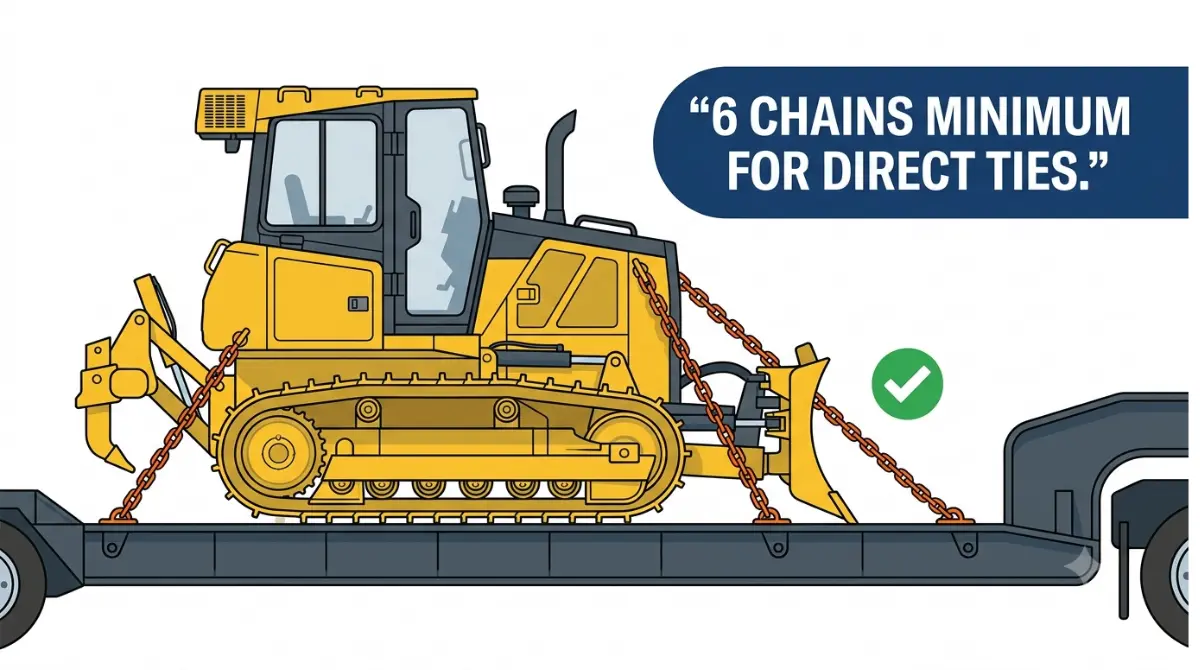
Table of Contents
How much chain a 700L dozer needs, by the WLL math
When chains run from the trailer straight to the dozer, their marked working load limits (WLL) must add up to the machine’s full weight. Four 3/8-inch Grade 70 chains total 26,400 lb, which is short of every 700L setup Deere publishes.
| Applies To (700L setup) | Weight, lb | 4× 3/8″ Grade 70 | 6× 3/8″ Grade 70 | 4× 1/2″ Grade 70 |
|---|---|---|---|---|
| XLT, base | 30,900 | ✗ | ✓ | ✓ |
| LGP, base | 32,088 | ✗ | ✓ | ✓ |
| XLT + ripper | 34,083 | ✗ | ✓ | ✓ |
| LGP + ripper, rock guards, cab | 36,120 | ✗ | ✓ | ✓ |
Weights: Deere 700L spec sheet DKALDZR700 (23-09). Each figure assumes standard equipment, ROPS, a full fuel tank and a 175-lb operator, with options added. Chain ratings: 49 CFR 393.108. Math: 49 CFR 393.106(d), direct tiedowns, with binders and anchors rated at or above the chain. Verified October 16, 2026.
The short answer for XLT, LGP and ripper builds
A ✓ means the kit meets the federal arithmetic. It does not mean the securement plan is complete. Deere’s full option breakdown is in our 700L weight by undercarriage and options, and your scale ticket, not the brochure, sets the weight you secure.
Hauling today, buying chain, or checking a carrier
- Hauling today: Read Sections 4 and 5 before the chains go on.
- Buying chain: Section 3 has the federal ratings by size and grade.
- Checking a carrier’s plan: Section 7 lists what to ask.
ℹ️ Safety Note: An under-rated chain kit can fail in a hard stop or turn and let the dozer shift or leave the trailer. That can crush anyone beside it. A binder handle under tension can also whip back when released. This article explains the federal WLL arithmetic only, and a licensed carrier or certified rigger should plan and perform the securement.
Four tiedowns is the minimum; 393.106 sets the math
Two federal rules apply at once. One sets the number of tiedowns and the other sets their combined strength.
What 393.130 requires for a tracked machine
📜 The Rule: Under 49 CFR 393.130(c), tracked or wheeled machinery of 10,000 lb or more must be restrained against lateral, forward, rearward and vertical movement with at least four tiedowns (eCFR current as of October 14, 2026). The count is a minimum, and it says nothing about strength.
Direct tiedowns count half toward aggregate WLL
The aggregate WLL rule in 49 CFR 393.106 sets a floor on the aggregate WLL, meaning the credited sum of all tiedowns. That sum must be at least half the cargo’s weight.
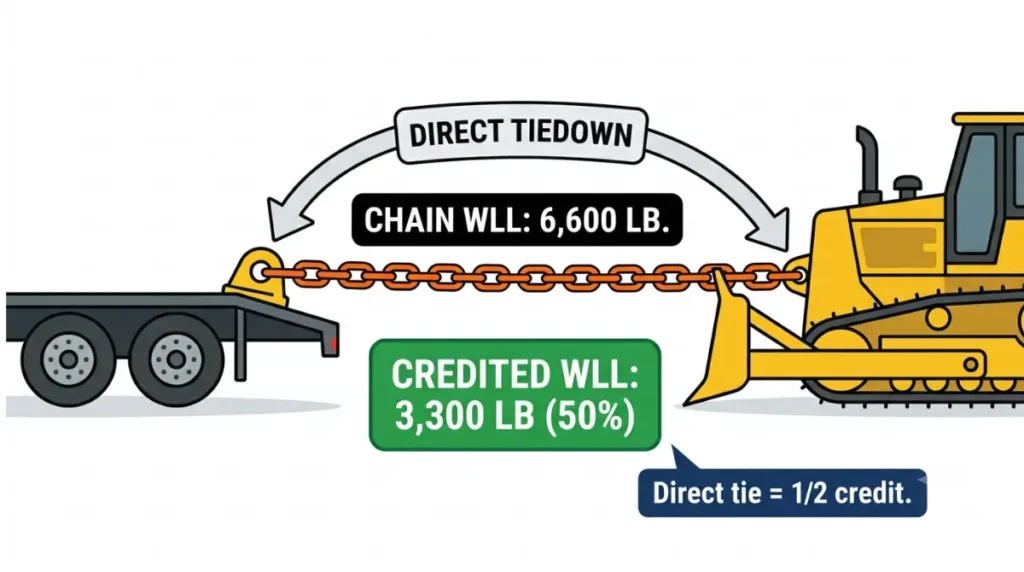
A direct tiedown runs from a trailer anchor to an anchor point on the machine. It is credited at only half its WLL. A tiedown counts in full only when it passes over, around or through the cargo to an anchor on the opposite side of the trailer.
🔍 Why It Fails: Halving the credit while requiring half the weight means direct-tied chains must total the machine’s whole weight. A guide that quotes “50% of weight” without the half-credit overstates what a chain kit can hold by a factor of two. Whether any chain on your 700L qualifies for full credit is a call for a DOT compliance consultant.
The 5,000-lb-per-tiedown figure in older handbook copies
An archived copy of FMCSA’s Driver’s Handbook on Cargo Securement says each tiedown on heavy equipment must have a WLL of at least 5,000 lb. The current text of 393.130 has no per-tiedown minimum. Every chain in Section 4’s passing rows rates above 5,000 lb, so the discrepancy doesn’t change a 700L answer.
Chain grade and size: the WLL each one carries
These are the federal ratings you plug into the math.
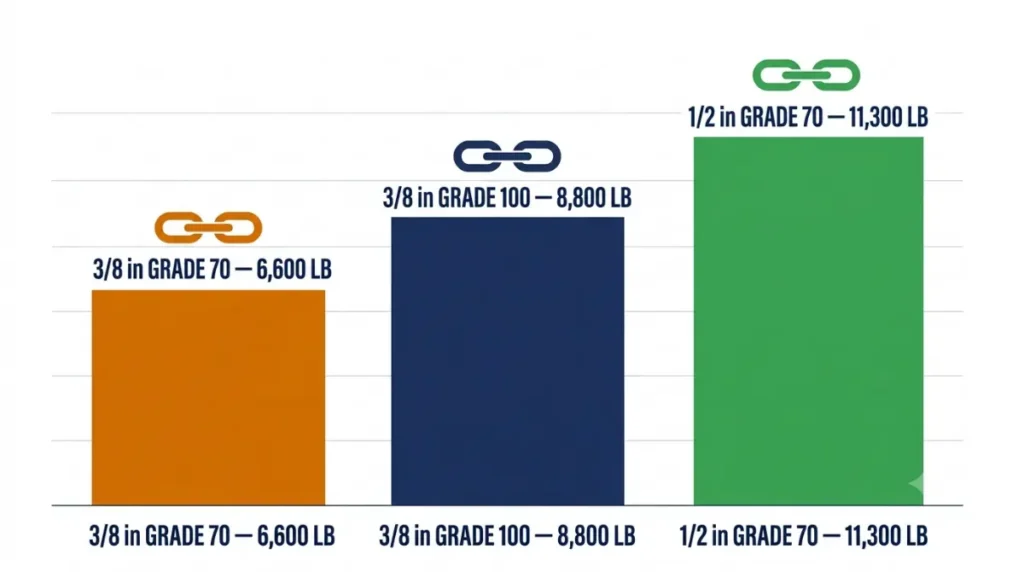
| Size, in (mm) | Grade 70, lb | Grade 80, lb | Grade 100, lb | Applies To |
|---|---|---|---|---|
| 5/16 (8) | 4,700 | 4,500 | 5,700 | Welded chain, grade stamped, no maker WLL tag |
| 3/8 (10) | 6,600 | 7,100 | 8,800 | Same |
| 7/16 (11) | 8,750 | not listed | not listed | Same |
| 1/2 (13) | 11,300 | 12,000 | 15,000 | Same |
Source: the federal chain WLL table, 49 CFR 393.108, eCFR current as of October 13, 2026. A manufacturer’s marked WLL replaces these values.
5/16 to 1/2 inch, Grades 43 to 100
Grade 43 high test at 3/8 inch is listed at 5,400 lb. The grade is stamped on the links; Grade 70, for example, is marked 7, 70 or 700.
Unmarked chain rates as Grade 30
Welded chain with no readable grade or WLL marking is rated as Grade 30 proof coil, which is 2,650 lb at 3/8 inch. Four unmarked 3/8-inch chains tied direct credit only 5,300 lb.
Why 5/16 Grade 80 rates below Grade 70
At 5/16 inch, the federal table lists Grade 80 at 4,500 lb and Grade 70 at 4,700 lb. Read the number, not the grade.
WLL math for a 700L XLT, LGP and ripper build
Each row below assumes every tiedown is direct.
| Kit (direct ties) | Credited aggregate, lb | XLT or LGP base (needs 15,450–16,044) | XLT + ripper (needs 17,042) | LGP + ripper, guards, cab (needs 18,060) |
|---|---|---|---|---|
| 4× 3/8″ Grade 70 | 13,200 | ✗ | ✗ | ✗ |
| 4× 3/8″ Grade 80 | 14,200 | ✗ | ✗ | ✗ |
| 5× 3/8″ Grade 70 | 16,500 | ✓ | ✗ | ✗ |
| 4× 7/16″ Grade 70 | 17,500 | ✓ | ✓ | ✗ |
| 4× 3/8″ Grade 100 | 17,600 | ✓ | ✓ | ✗ |
| 6× 3/8″ Grade 70 | 19,800 | ✓ | ✓ | ✓ |
| 4× 1/2″ Grade 70 | 22,600 | ✓ | ✓ | ✓ |
Weights: Deere DKALDZR700 (23-09): XLT 30,900 lb, LGP 32,088 lb, ripper +3,183 lb, rock guards +342 lb, cab +507 lb. WLLs: 49 CFR 393.108. Arithmetic checked October 16, 2026.
The formula with inputs shown
Credited aggregate equals half the sum of the marked WLLs, and the requirement equals half the operating weight. That means direct-tied chains must total at least the machine’s weight. Four 3/8-inch Grade 70 chains give 4 × 6,600 = 26,400 lb, which is 4,500 lb short of even the lightest 700L.
Four chain kits against four 700L weights
Every row assumes each binder, hook and trailer anchor is rated at or above its chain (see Section 5). Chains on the blade or ripper are not counted.
🧮 Run the Numbers: In the Tie-Down Requirement (WLL) Calculator, enter your scale-ticket weight, the number of tiedowns, chain size and grade (or marked WLL), binder WLL, and whether each tie is direct.
✅ Do This: Ask a DOT compliance consultant or certified rigger which of your tiedowns count as direct. Then ask them to confirm that the credited total clears your scale-ticket weight, not the brochure figure.
Same math for any Deere dozer
Direct-tied WLLs must total the machine’s weight, whatever the model. Pull the base figure from our operating weights for other Deere dozers, add your options, and size chain the same way.
Binders, hooks and D-rings cap the chain’s rating
A chain kit is only as strong as its weakest part.
The weakest part sets the tiedown’s WLL
Under 49 CFR 393.108(a), a tiedown’s WLL is the lowest rating among its parts, binder included, or the rating of its anchor points if that is lower. A 3/8-inch Grade 70 chain on a binder marked below 6,600 lb is rated at the binder’s marking. The same applies to a hook or D-ring rated lower than the chain.
Trailer anchors and Deere’s designated points
393.130 allows tiedowns to attach at mounting points designed for that purpose. Deere’s operator’s manual for your 700L’s serial number shows where they are, and this article doesn’t locate them.
⚠️ Hazard: Chain hooked to a component that isn’t rated for tiedown loads can bend it or let go under braking, and the dozer can shift off the deck. A certified rigger or licensed carrier should choose the attachment points from Deere’s manual.
✅ Do This: Buy chain stamped with its grade and binders marked with a WLL at or above the chain’s, because the markings are what an inspector reads. If a part carries no marking, get its rating in writing from the maker before counting on it.
Blade and ripper down: the prep rule before chains
The machine is prepared before any chain goes on.
Accessories lowered and secured
📜 The Rule: 49 CFR 393.130(b)(1) requires accessory equipment to be completely lowered and secured to the vehicle (eCFR current as of October 14, 2026). FMCSA’s guidance on accessories wider than the trailer (issued April 4, 1997) allows such accessories to ride raised only if they are designed to be transported that way, and they must be locked in place.
Deere lists 700L blades at 121–145 in wide straight (DKALDZR700, 23-09). How the blade and ripper ride is a question for Deere’s manual and your carrier.
Parking brake set
FMCSA’s handbook says to set the parking brake on transported equipment. Deere’s sheet says the 700L’s wet multi-disc parking brake engages whenever the engine stops.
✅ Do This: Ask your licensed carrier how the blade and ripper will ride and be locked, per Deere’s manual for your serial number.
Permits, scale tickets and who signs the securement plan
The securement plan has to work for the permit as well as for Part 393.
Permit loads can carry their own securement terms
🗺️ State Check:
- Federal baseline: Part 393 securement for interstate carriers. FMCSA’s handbook notes that loads moved under special permits follow the permit’s securement terms, which may differ.
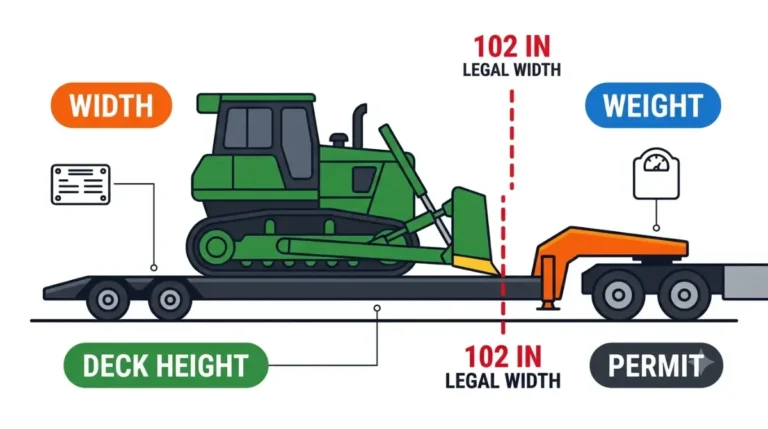
- Range: Oversize permits are issued state by state, and every Deere 700L blade exceeds 102 in.
- What to look up: Each route state’s oversize permit conditions, including any securement terms. Start with whether your 700L is over 102 inches.
What to hand your carrier
✅ Do This: Give a licensed heavy-haul carrier:
- your scale-ticket weight with options;
- chain count, size and grade, or marked WLL;
- binder and anchor WLLs;
- which tiedowns are direct;
- how the blade and ripper will ride.
Tie down John Deere dozer FAQ
1. How many chains to tie down a John Deere 700L?
At least four tiedowns, and direct-tied chains’ marked WLLs must total the 700L’s weight, 30,900–36,120 lb in Deere-sheet builds. Have a certified rigger confirm the plan.
2. Are four 3/8-inch Grade 70 chains enough for a 700L?
No. Four 3/8-inch Grade 70 chains tied direct credit 13,200 lb, below the 15,450 lb the lightest 700L requires.
3. What is aggregate working load limit?
Aggregate working load limit is the credited sum of all tiedowns, which 49 CFR 393.106(d) requires to reach half the cargo’s weight.
4. Why do direct tiedowns count half?
Under 393.106(d)(1), a direct tiedown running from a trailer anchor to the machine is credited at half its working load limit.
5. What is the WLL of 3/8-inch Grade 70 chain?
Without a maker’s marking, 3/8-inch Grade 70 chain is rated 6,600 lb in 49 CFR 393.108; a marked WLL replaces that.
6. What WLL does chain with no grade mark have?
Chain with no grade or WLL mark is rated as Grade 30 proof coil under 393.108(d), which is 2,650 lb at 3/8 inch.
7. Does the binder rating limit the chain?
Yes. Under 393.108(a), a tiedown’s WLL is its weakest part’s rating, binder and trailer anchor included. Ask your carrier for each part’s marked rating.
8. Does a ripper change the chain math on a 700L?
Yes. Deere lists the 700L ripper at 3,183 lb, and ripper builds clear with six 3/8-inch or four 1/2-inch Grade 70 chains.
9. Must a dozer’s blade be secured for transport?
Yes. 393.130 requires accessories lowered and secured, or locked in place if designed to ride raised, per FMCSA guidance. Your carrier sets the method.
10. Is Grade 80 chain always stronger than Grade 70?
No. At 5/16 inch, the federal table rates Grade 80 chain at 4,500 lb and Grade 70 at 4,700 lb.
Where this leaves you
You now know whether your chain kit meets the federal arithmetic for your 700L, and the default four-chain kit doesn’t. The next question is width and permits: start with 700L dimensions for hauling, and see Deere construction equipment specs by configuration for other models.
Run your kit through the Tie-Down Requirement (WLL) Calculator with your scale-ticket weight, chain size, grade and binder WLL. The one thing to hire out is the check of which tiedowns are direct and whether the credited total clears that weight; ask a DOT compliance consultant or certified rigger.