John Deere 750 vs 850 Dozer by Undercarriage and Blade

The John Deere 750 and 850 carry the same rated load on PAT blades. On OSD Semi-U blades the 850 holds 7.3 to 8.0 cu yd against the 750’s 5.6.
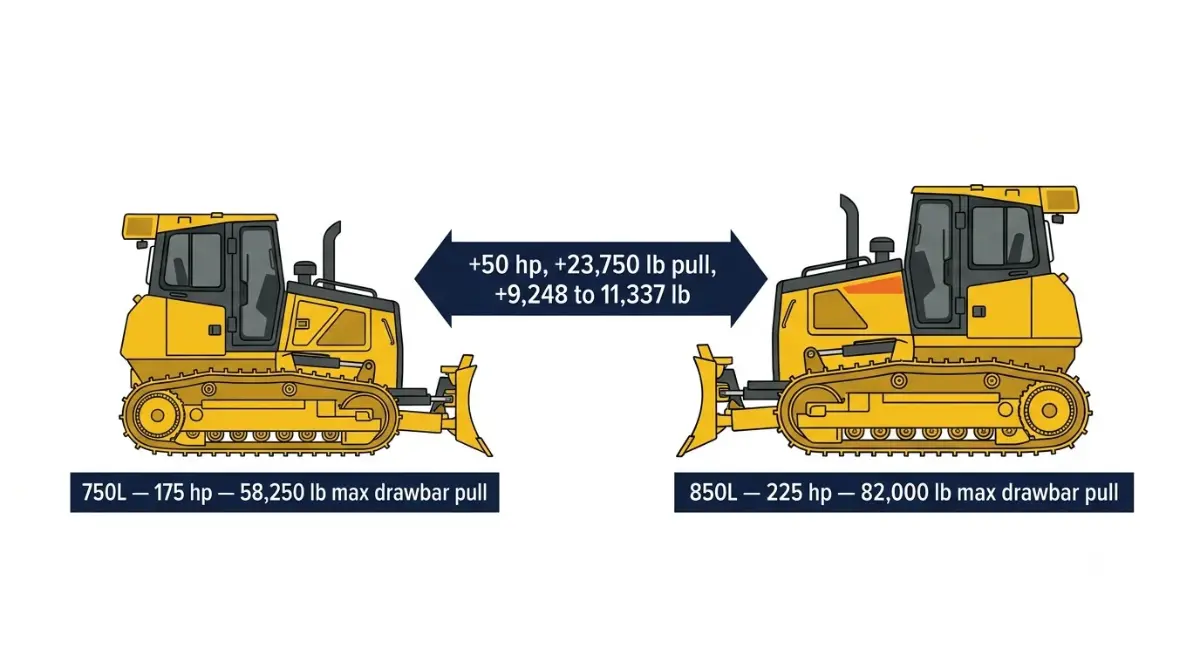
Table of Contents
Specs and rules checked on October 27, 2026.
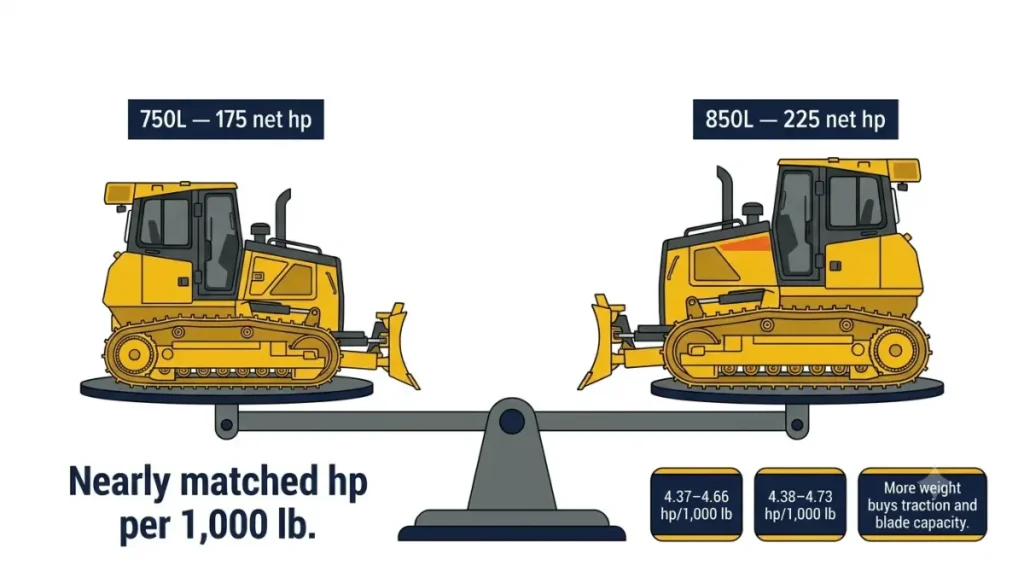
The John Deere 850 makes 225 net hp to the 750’s 175, and it weighs 9,248 to 11,337 lb more when you compare like setups. Matched that way, the two carry almost the same power for their weight, so the differences you pay for are drawbar pull, blade size on outside-dozer (OSD) machines and how hard each one presses on soft ground.
These figures cover the current 750L and 850L, which Deere also lists as the 750 P-Tier and 850 P-Tier. Older crawlers from the B through K series, and the 1980s Deere compact tractors that shared these model numbers, are different machines with different specs.
Weight and power for each 750 and 850 setup
Deere’s base weight includes standard equipment, a ROPS, a full fuel tank and a 175 lb operator. A cab, ripper, counterweight or rock guards add to it.
| Applies to (undercarriage, blade, blade width) | Base weight, lb (kg) | Net hp | hp per 1,000 lb |
|---|---|---|---|
| 750L XLT, PAT, 130 in | 37,569 (17,041) | 175 | 4.66 |
| 750L Standard, OSD Semi-U, 129 in | 38,330 (17,386) | 175 | 4.57 |
| 750L LGP, PAT, 156 or 161 in | 39,976–40,040 (18,133–18,162) | 175 | 4.37–4.38 |
| 850L XLT, OSD Semi-U, 129 in | 47,578 (21,581) | 225 | 4.73 |
| 850L XLT, PAT, 146 in | 48,779 (22,126) | 225 | 4.61 |
| 850L WLT, OSD Semi-U, 141 in | 49,400 (22,407) | 225 | 4.55 |
| 850L WLT, PAT, 158 or 168 in | 50,250–50,325 (22,793–22,827) | 225 | 4.47–4.48 |
| 850L LGP, OSD Semi-U, 153 in | 51,356 (23,295) | 225 | 4.38 |
| 850L LGP, PAT, 168 or 172 in | 51,313–51,365 (23,275–23,299) | 225 | 4.38 |
Source: Deere spec sheets DKALDZR750 (23-09) and DKALDZR850 (23-09). Net power is rated at 1,700 rpm on both. Neither sheet states a serial range. The last column is net hp divided by base weight in thousands of pounds.
XLT is the extra-long track, LGP the low-ground-pressure track with wider shoes, and WLT the wide long track that only the 850 offers. A PAT (power-angle-tilt) blade angles and tilts from the cab on a C-frame; an OSD blade mounts outside the tracks on push beams.
Set XLT against XLT on PAT blades and the bigger machine is 11,210 lb heavier. On LGP the gap is 11,325 to 11,337 lb. The closest OSD pair, a 750 Standard against an 850 XLT, sits 9,248 lb apart, because the 750 offers its OSD blade only on the Standard undercarriage, with 103 in of track on the ground against 122 in under its XLT and LGP. Every 850 runs 130 in of track on eight rollers a side.
Pull, flow and ripper: where the extra weight goes
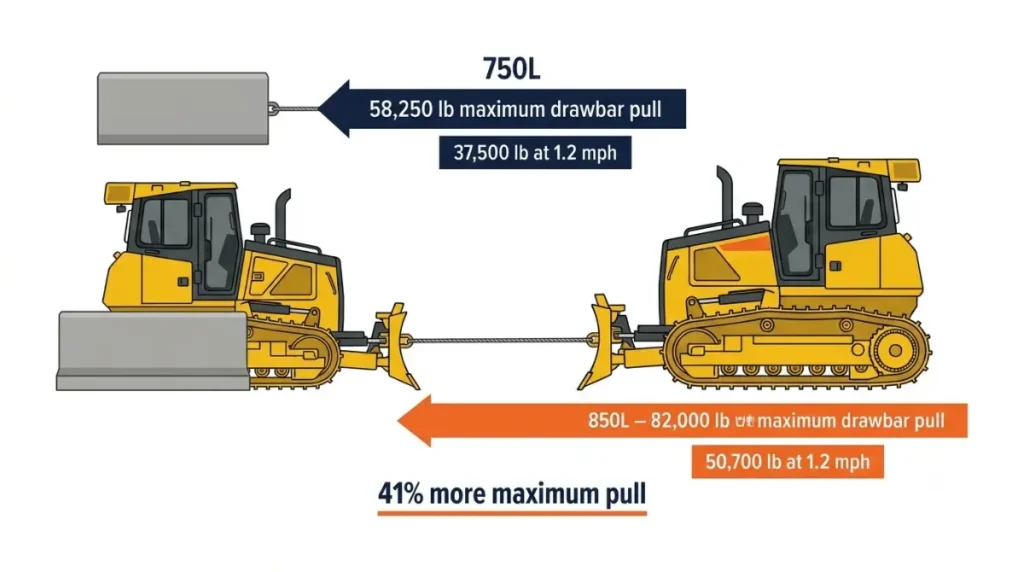
Maximum drawbar pull is 82,000 lb (365 kN) on the 850 against 58,250 lb (259 kN) on the 750, a 41 percent gap. Drawbar pull is the force the tracks can put on a load behind the machine.
| Applies to (all 750L and 850L setups) | 750L | 850L |
|---|---|---|
| Drawbar pull, maximum | 58,250 lb | 82,000 lb |
| Drawbar pull at 1.2 mph | 37,500 lb | 50,700 lb |
| Drawbar pull at 2.0 mph | 23,750 lb | 32,000 lb |
| Hydraulic pump flow, unloaded high idle | 34 gpm (130 L/min) | 41 gpm (155 L/min) |
| 3-shank parallelogram ripper | 4,314 lb (1,957 kg) | 4,750 lb (2,155 kg) |
Pull, flow and ripper weights from the 750L sheet and the 850L sheet. Neither says which undercarriage the pull figures were measured on.
At working speed the gap narrows to about 35 percent, still 13,200 lb more pull at 1.2 mph. Hydraulic relief is 3,625 psi on both machines; the 850 moves about 21 percent more oil through a 74 cc pump against the 750’s 63 cc.
Divide net hp by base weight and the pairs land within a few hundredths. On XLT tracks with PAT blades, the 750 works out to 175 ÷ 37.569 = 4.66 hp per 1,000 lb and its bigger sibling to 225 ÷ 48.779 = 4.61. On LGP both come to about 4.38. The 850 adds pull and blade without changing the power-to-weight ratio.
The 850’s net peak torque is 831 lb-ft at 1,500 rpm. No torque figure appears on the 750 sheet, so there is nothing to set it against.
Blade choice changes the size gap
On power-angle-tilt blades, the 750 and 850 carry the same rated load undercarriage for undercarriage. Move to OSD Semi-U blades and the 850 carries 30 to 43 percent more.
| Applies to | 750L SAE capacity, blade width | 850L SAE capacity, blade width |
|---|---|---|
| XLT, PAT blade | 5.2 cu yd (3.9 m³), 130 in | 5.2 cu yd (3.9 m³), 146 in |
| LGP, PAT blade | 5.9–6.0 cu yd (4.5–4.6 m³), 156–161 in | 5.9–6.0 cu yd (4.5–4.6 m³), 168–172 in |
| OSD Semi-U blade | 5.6 cu yd (4.3 m³), 129 in, Standard track | 7.3–8.0 cu yd (5.6–6.2 m³), 129–153 in, XLT to LGP |
Capacities and widths from Deere’s 750L and 850L spec sheets. SAE capacity is the rated blade load each sheet prints.
The PAT numbers match because the 850’s PAT blades are wider and lower. On XLT the 850 blade is 16 in wider and 48 in high against the 750’s 57 in. Deere pitches its 172 in PAT option, which it calls the widest in the class, at grading on larger sites.
A Semi-U blade has short side wings that hold material in front of the blade while pushing. The 750 offers one Semi-U, 129 in on the Standard track. The 850 offers three, from 7.3 cu yd at 129 in on XLT to 8.0 cu yd at 153 in on LGP, plus a 194 in mechanical-angle blade rated 6.4 cu yd.
A WLT machine with the 158 in PAT blade is rated 5.5 cu yd and has no 750 counterpart.
Which setup leaves the lightest footprint?
The 750 LGP does, at 4.42 psi (30.5 kPa) with its 34 in shoes. The next lightest is the 850 LGP at 5.0 psi on 36 in shoes.
| Applies to | Base weight, lb | Ground contact area, sq in | Ground pressure, psi (kPa) |
|---|---|---|---|
| 750L LGP, PAT | 39,976–40,040 | 9,048 | 4.42–4.43 (30.5) |
| 850L LGP, PAT or OSD | 51,313–51,365 | 10,200 | 5.0 (34.4) |
| 850L WLT, OSD | 49,400 | 8,519 | 5.8 (39.7) |
| 850L WLT, PAT | 50,250–50,325 | 8,519 | 5.9 (40.4) |
| 750L XLT, PAT | 37,569 | 5,926 | 6.34 (43.7) |
| 850L XLT, OSD | 47,578 | 6,838 | 6.9 (47.9) |
| 750L Standard, OSD | 38,330 | 5,530 | 6.93 (47.8) |
| 850L XLT, PAT | 48,779 | 6,838 | 7.1 (49.1) |
Printed pressures at base weight, from DKALDZR750 and DKALDZR850.
Ground pressure is base weight spread over the track area touching the ground, and Deere’s printed figures check out. For the 750 LGP, 39,976 ÷ 9,048 = 4.42 psi. For the 850 LGP, 51,313 ÷ 10,200 = 5.03, printed as 5.0.
Options change the answer. Hang the 4,314 lb ripper on a 750 LGP and it rises to 44,290 ÷ 9,048 = 4.90 psi. The same move on an 850 LGP with the 172 in PAT blade gives 56,115 ÷ 10,200 = 5.50 psi.
The 850 WLT, on 30 in shoes, is the middle ground the 750 does not have.
750L, 850L, P-Tier and the 850 X-Tier
Two Deere documents can give two answers for the same machine. Match the serial number to a spec sheet before you trust a listing.
Deere’s mid-size dozer listing gives the 750 P-Tier 37,569–40,040 lb and its larger P-Tier sibling 47,578–51,365 lb, the same ranges as the L-series sheets. That matches the L-series to P-Tier name changes across Deere’s line.
| Applies to | One Deere figure | Another Deere figure | Go by |
|---|---|---|---|
| 750 rated engine speed | 1,700 rpm on DKALDZR750 and the 750 P-Tier page | 1,800 rpm on the 750L compare table | The sheet, then the dealer by serial |
| 750 final drive | Double-reduction planetary on DKALDZR750 | Triple reduction on the 750L compare table | The dealer by serial |
| 850 engine name | PowerTech PSS 6090 on DKALDZR850 | JD9 on the 850 P-Tier page; both 9.0 L, 225 hp | The engine plate |
| 750 height with limb risers | 3,343 mm, printed as 11 ft 6 in | 3,343 mm converts to 10 ft 11.6 in | The millimeter figure |
Emissions differ on paper. The 750L engine meets EPA Final Tier 4 and EU Stage V on its sheet, the 850L Final Tier 4 and EU Stage IV. EPA sets the Tier 4 nonroad diesel standards in 40 CFR Part 1039, listed on EPA’s page for heavy equipment diesel engine rules.
The 850 also comes as the 850 X-Tier E-Drive, at 47,978–51,765 lb on the same mid-size listing. That is 400 lb over the P-Tier version at both ends, with the same 225 hp rated at 1,600 rpm instead of 1,700. No 750 X-Tier appears. Before pricing one, read what the X-Tier E-Drive warranty covers.
Deere’s recall information page listed no 750 or 850 dozer recall on October 27, 2026. Product Improvement Programs are looked up by serial number on that page. Ask a Deere dealer: “Which spec sheet, engine and open Product Improvement Programs match my machine’s serial number?”
Getting a haul quote for the setup you pick
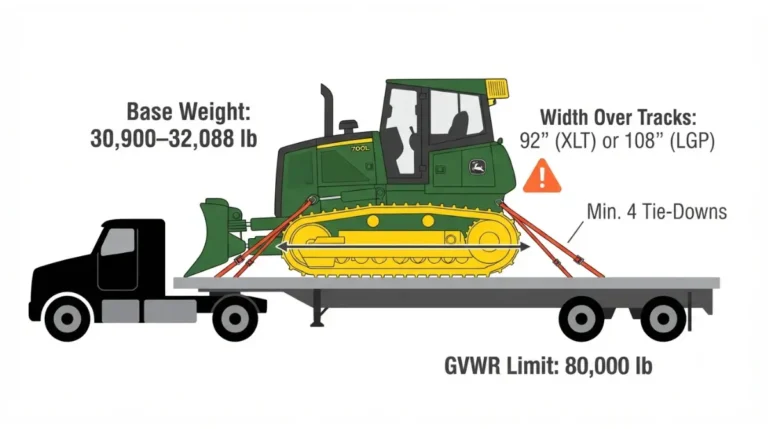
With the blade off, three setups come in under the 102 in federal width baseline: the 750 on XLT or Standard track at 96 in over the tracks, and an 850 XLT built for an OSD blade at 98 in. Every other setup measures 108 to 132 in over the tracks.
With any blade fitted, every setup of both machines is over 102 in. That width is set for the National Network in 23 CFR 658.15, which lets each state issue permits for wider loads on its own terms. The state-by-state oversize permit triggers for Deere dozers show where each setup lands.
Hazard: A dozer that shifts on the deck can slide off the trailer and crush anyone beside it, and a load wider than its permit can strike oncoming traffic or bridge rails. Loading, blade removal and tiedowns are work for a licensed heavy-haul carrier following the Deere operator’s manual.
For an 850, the 850L trailer, deck height and tiedown figures cover each configuration. For either machine, the 80,000 lb headroom for every Deere dozer shows what is left for the tractor and trailer. Ask the carrier: “What does this setup weigh on the scale, and how wide and tall does it ride with the blade on and with it off?”