Legal Axle Weight for Equipment Hauling Under Frost Laws

Frost laws for equipment hauling cut axle weight on Michigan seasonal routes 25% on concrete and 35% on asphalt. Compare five states before you load.
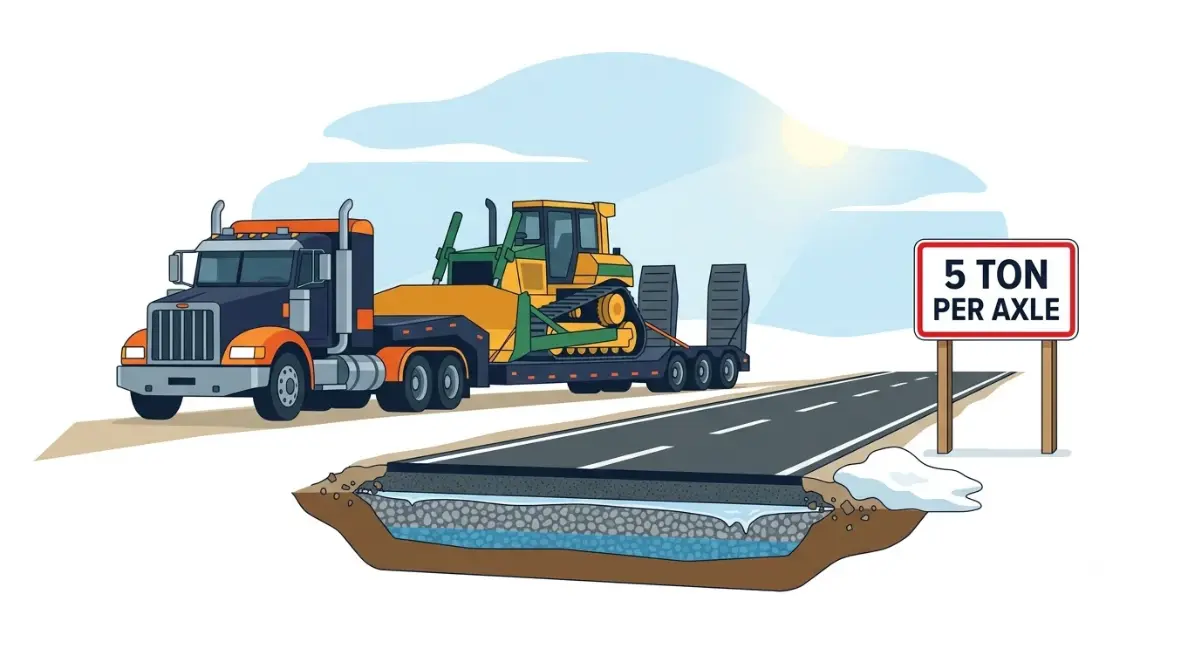
Table of Contents
Frost laws and your equipment haul: the short answer
Frost laws reduce the weight each axle may carry on thaw-weakened state, county and local roads. They take effect around February or March and usually wind down in April or May. Each state writes the limit differently:
- Minnesota drops unpaved roads to 5 tons per axle, while unposted paved roads stay at 10 tons.
- Michigan’s “seasonal” routes cut axle weight 25% on concrete and 35% on asphalt.
- Pennsylvania requires hauler agreements and bonds (Section 7).
Interstates are different. States must allow 20,000 lb on a single axle, 34,000 lb on a tandem, and at least 80,000 lb gross for combinations of five or more axles.
- What “5-ton” means in pounds: Section 3
- Your state’s rules: Section 2
- Axles for an 850L: Section 4
- Interstates and permits: Section 5
ℹ️ Safety Note: Thaw leaves the base under the pavement saturated. The road edge and gravel shoulder are the weakest points and can easily break or fail under heavy loads. This article is for general understanding only. Confirm your route and axle loads with the posting authority or a licensed heavy-haul carrier before loading.
Frost laws by state: how each one sets the limit
The table shows six jurisdictions, and each one writes its frost limit in a different legal form.
| State | How the limit is written | Restricted limit | 2026 window |
|---|---|---|---|
| Minnesota | Tons per axle | Unpaved roads 5-ton; paved roads 10-ton unless posted lower | South, Southeast, Metro: Mar 3 – Apr 20. North: Mar 20 – May 15 |
| Michigan | Percentage cut | Seasonal routes −25% (concrete) / −35% (asphalt); all-season routes no cut | Southern trunklines from Feb 17; south lifted Mar 30 |
| Wisconsin | Class II roads + posted roads | Regional example (2024): 6 tons single axle, 24 tons gross | Zones 1–2 ended Apr 30 |
| North Dakota | “By legal weight” or posted tonnage | 20,000 lb single / 34,000 lb tandem / 105,500 lb gross | |
| Pennsylvania | Posted and bonded | Hauler agreement + security (Section 7) | Mostly early spring |
| Ohio (Harrison County) | Percentage cut + bond | Legal limits −50% on county and township roads | Set by the county |
Sources for each row are listed below. All verified October 17, 2026.
State-level details behind the table:
- Minnesota: the 2026 dates come from MnDOT’s spring load restriction table.
- Michigan: restrictions began Feb. 17, 2026 on southern trunklines. MDOT lifted them across southern Michigan on March 30. Highways north of the US-10/M-61 line stayed restricted into April.
- Wisconsin:
- Class II roads cover about 1,400 miles of thaw-sensitive state highway.
- Seasonal postings cover roughly 170 miles across 13 segments.
- The 6-ton single axle and 24-ton gross figures come from WisDOT’s 2024 North Central Region posting. That posting also capped any two axles less than 8 ft apart at 10 tons.
- North Dakota: the “by legal weight” restriction keeps a single axle at 20,000 lb, a tandem at 34,000 lb, and gross weight at 105,500 lb.
- Ohio: in Harrison County, the 50% cut applies during the freeze/thaw period. Hauling then requires a $500-per-mile bond and is allowed only while the road is frozen.
Local roads change the answer. Michigan county road commissions set their own restrictions, which don’t always match MDOT’s. North Dakota counties may also set limits that differ from the state’s.
🗺️ State Check: Interstates follow the federal baseline in Section 5. Every other road follows the state or local posting authority, so the limit can change at a county line. For each road on your route, look up the posting authority, the legal form (tons, percent, or bond), and the current start and end dates.
The current postings live on MnDOT’s seasonal load limits page, MDOT’s spring weight restrictions page, and WisDOT’s seasonal posted roads list. You can also look up your state’s frost law status in our State Permit & Frost Law Lookup.
📜 The Rule: Minn. Stat. § 169.87, Subd. 2 sets the default limits during the restricted period. Unpaved roads are limited to 5 tons per axle, and paved roads to 10 tons per axle unless posted lower.
What a “5-ton” or “10-ton” road means in pounds
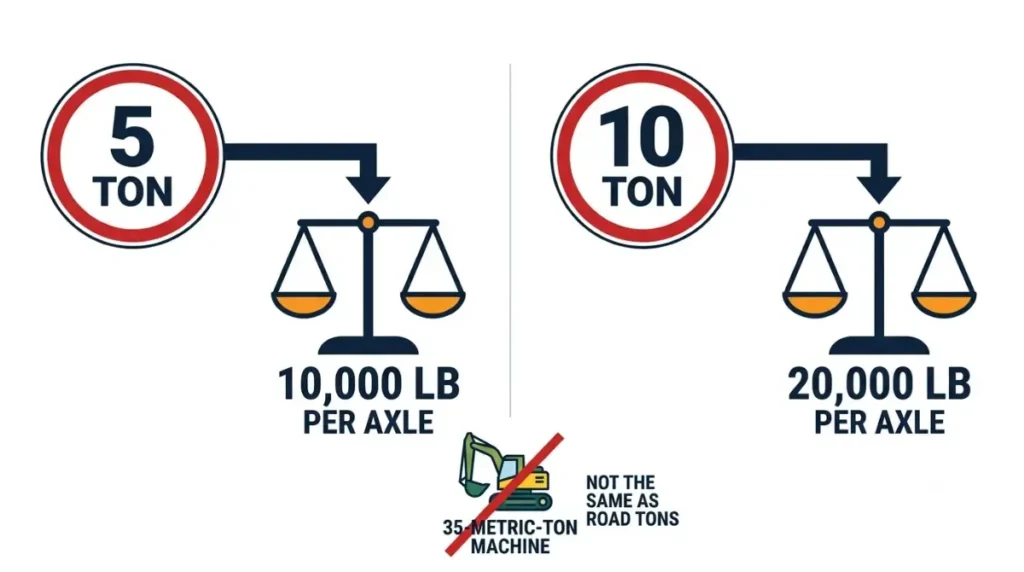
On a posted road, “ton” means US short tons per axle. It is not a machine size class.
| Posted axle limit | Single axle max | Applies To |
|---|---|---|
| 10-ton | 20,000 lb | Minnesota (all paved roads unless signed lower) |
| 9-ton | 18,000 lb | Minnesota (all unpaved roads unless signed lower) |
| 7-ton | 14,000 lb | Minnesota (posted) |
| 5-ton | 10,000 lb | Minnesota (posted, and the spring default on unpaved roads) |
Source: MnDOT Truck Book, Section 04 (2022 edition). The full schedule runs down to 4-ton = 8,000 lb. Verified October 17, 2026. The editor should check for a newer edition.
Don’t mix the two kinds of “ton.” A “35-metric-ton” excavator describes the machine’s size. A “5-ton” sign limits each axle to 10,000 lb. Never size a move on one when the rule means the other.
🔍 Why It Fails: As frost leaves the ground, the gravel under the pavement holds a lot of water. That weakens how much load the asphalt can carry.
How many axles a Deere 850L needs under frost limits
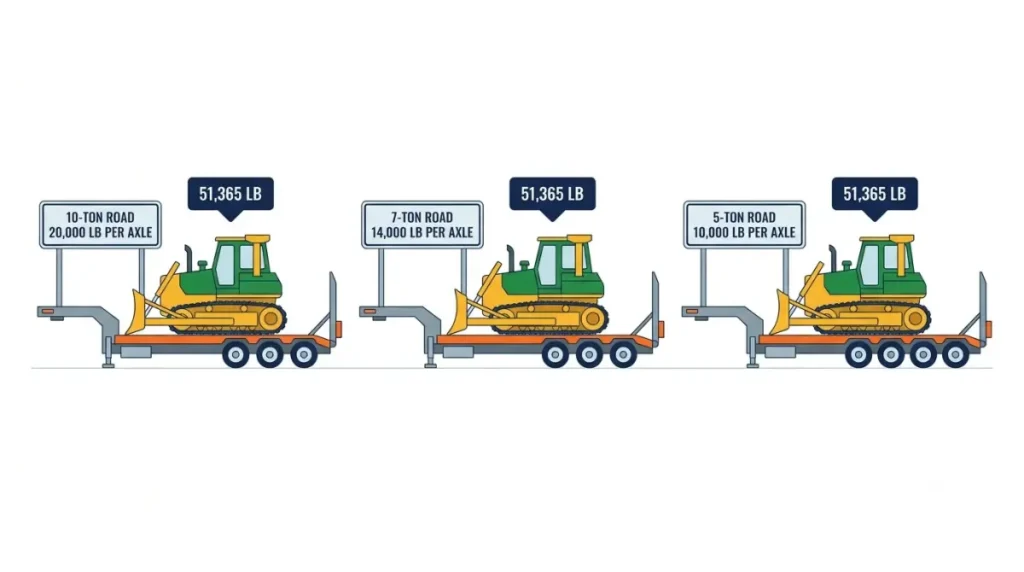
This section runs the numbers on one machine, with every input shown.
📋 Verified Spec: John Deere 850L crawler dozer, current model: operating weight 47,578–51,365 lb (21,581–23,299 kg). Deere publishes it as a range across configurations. Source: Deere 850L product specifications. Verified October 17, 2026.
That range is the only figure this page shares with our Deere operating weights by configuration reference. The table uses the top of the range as the conservative case.
| Per-axle limit | Calculation (machine only) | Minimum loaded axles | Applies To |
|---|---|---|---|
| 20,000 lb (10-ton) | 51,365 ÷ 20,000 = 2.57 | 3 | 850L, top of OEM range |
| 14,000 lb (7-ton) | 51,365 ÷ 14,000 = 3.67 | 4 | 850L, top of OEM range |
| 10,000 lb (5-ton) | 51,365 ÷ 10,000 = 5.14 | 6 | 850L, top of OEM range |
Source: arithmetic on the Deere spec and the MnDOT limits above. Verified October 17, 2026.
These counts are a floor, not a legality test. They leave out tractor and trailer tare, axle-group and tandem limits, bridge formula, and how unevenly the load sits across the axles.
🧮 Run the Numbers: Put your certified scale-ticket tare, the machine’s configured weight, your axle spacing, and the posted limit into the Axle Weight Distribution Calculator.
✅ Do This: Before booking, ask your licensed heavy-haul carrier for the axle-by-axle weights on the actual combination they’ll run. Then check that every axle is under the posted limit for each restricted segment.
The full trailer, securement and route walkthrough is in how to haul a John Deere 850L.
Do frost laws apply to interstates and overweight permits?
📜 The Rule: 23 U.S.C. § 127 ties a state’s federal highway funding to allowing 20,000 lb per single axle, 34,000 lb per tandem, and at least 80,000 lb gross for 5+ axle combinations on the Interstate System. Verified October 17, 2026.
That federal floor protects legal-weight trucks on interstates. Overweight permits are still up to each state:
- Minnesota: permits over 80,000 lb continue during restrictions, but only if every axle and axle group is legal. In 2026, middle-range overweight permits reopened as each zone’s restrictions lifted. Full-summer permits followed later: Metro on May 8 and North on June 1.
- North Dakota: its permit policy treats permitted moves on I-29 and I-94 as unaffected by spring thaw.
The interstate is rarely the whole trip. The last miles to a jobsite are usually on restricted state, county or township roads. For state-by-state permit thresholds, see oversize permits for dozers by state.
When frost laws start and end, and how states decide
Frost-law dates change every year, so treat 2026 as history, not a forecast.
| State | How the dates are set |
|---|---|
| Minnesota | Every start and end takes effect at 12:01 a.m., with at least three days’ notice |
| Michigan | MDOT measures frost depth, watches road conditions, and tracks weather forecasts |
| Wisconsin | Frost tubes (liquid-filled gauges under the pavement) help decide when roads are frozen or thawed |
Sources: MnDOT, MDOT and WisDOT publications. Verified October 17, 2026.
Winter weight increases don’t help equipment haulers. Wisconsin’s frozen-road declaration raises gross weight to 98,000 lb only for 5+ axle trucks hauling logs, or salt and sand for winter road maintenance. Equipment hauls don’t qualify.
What hauling through frost season costs: bonds, fees, liability
Moving during restrictions is sometimes possible, but you pay for the road.
- Pennsylvania: a permitted hauler signs an Excess Maintenance Agreement. That legally makes the hauler responsible for road damage beyond normal wear on any posted road it uses above the limit. PennDOT sets four different security amounts depending on the road type and the agreement.
- North Dakota: the 2026 permit policy charges a permit fee plus a ton-mile fee on top of the restricted limits.
- Ohio: in Harrison County, frost-period hauling needs a $500-per-mile bond.
- Minnesota: penalties for violating spring load restrictions fall under §§ 169.88, 169.871 and 169.89.
✅ Do This: If the job can’t wait, ask the posting authority or a DOT compliance consultant two questions: does a permit, bond or agreement exist for this road, and what does it cost per mile? Ask before the machine is loaded.
See the PennDOT posted and bonded roadway FAQ for how Pennsylvania’s agreements work.
Frost laws FAQ
1. What are frost laws?
Frost laws are seasonal limits on axle weight on thaw-weakened roads. They’re set by state, county or local posting authorities during spring thaw.
2. When do frost laws start?
Usually late winter. In 2026, Michigan’s frost laws began February 17 on southern trunklines, and Minnesota’s began March 3 in its southern zones.
3. When do frost laws end?
When the roadbeds recover. Minnesota’s 2026 frost laws ended between April 20 and May 15 depending on zone, and Wisconsin’s northern zones ended April 30.
4. Which states have frost laws?
Minnesota, Michigan, Wisconsin, North Dakota and Pennsylvania all set seasonal limits, and some counties elsewhere, like Harrison County, Ohio, do too. Check the frost law lookup for your route.
5. What does a 10-ton road mean?
In Minnesota, a 10-ton road allows 20,000 lb per single axle. A 5-ton road allows 10,000 lb.
6. Do frost laws apply to interstates?
Federal law ties funding to states allowing 20,000 lb single, 34,000 lb tandem and 80,000 lb gross on interstates, so legal-weight trucks keep full weight there. Confirm the restricted roads off the interstate.
7. Can I get an overweight permit during frost laws?
In Minnesota, yes, but only if every axle and axle group stays legal under the frost laws. Confirm with the state permit office.
8. What does it cost to haul on posted roads?
Under Pennsylvania’s frost laws, haulers sign Excess Maintenance Agreements and pay for damage beyond normal wear. Ask the posting authority for its bond terms.
9. Does Wisconsin’s frozen-road weight increase cover equipment?
No. The Wisconsin frozen-road increase applies only to logs and to salt or sand hauled for winter road maintenance, not to equipment.
10. How many axles does a Deere 850L need under a 5-ton frost law?
At least six loaded axles for the machine alone, using 51,365 lb, before tractor and trailer tare. Have your carrier confirm the actual axle weights.
Plan the move before the posting goes up
If a Deere machine has to move between February and May, work through it in this order:
- Find the legal form your state uses (tons per axle, percentage, or bond).
- Convert the limit to pounds per axle.
- Check the machine’s configured OEM weight.
- Check every restricted segment on the route.
- Then choose between a permit, a bond, a different route, or waiting.
For the trailer and route itself, go next to how to haul a John Deere 850L. Run your scale-ticket numbers through the Axle Weight Distribution Calculator. Before you load, have a licensed heavy-haul carrier confirm every axle is under the posted limit on every segment.