Rent vs Buy Dozer Math Built on Actual Hours and Deere Prices

Rent or buy a Deere dozer? John Deere Financial counts 176 hours a month as full use; we convert that into annual breakeven hours and price a 650 P-Tier.
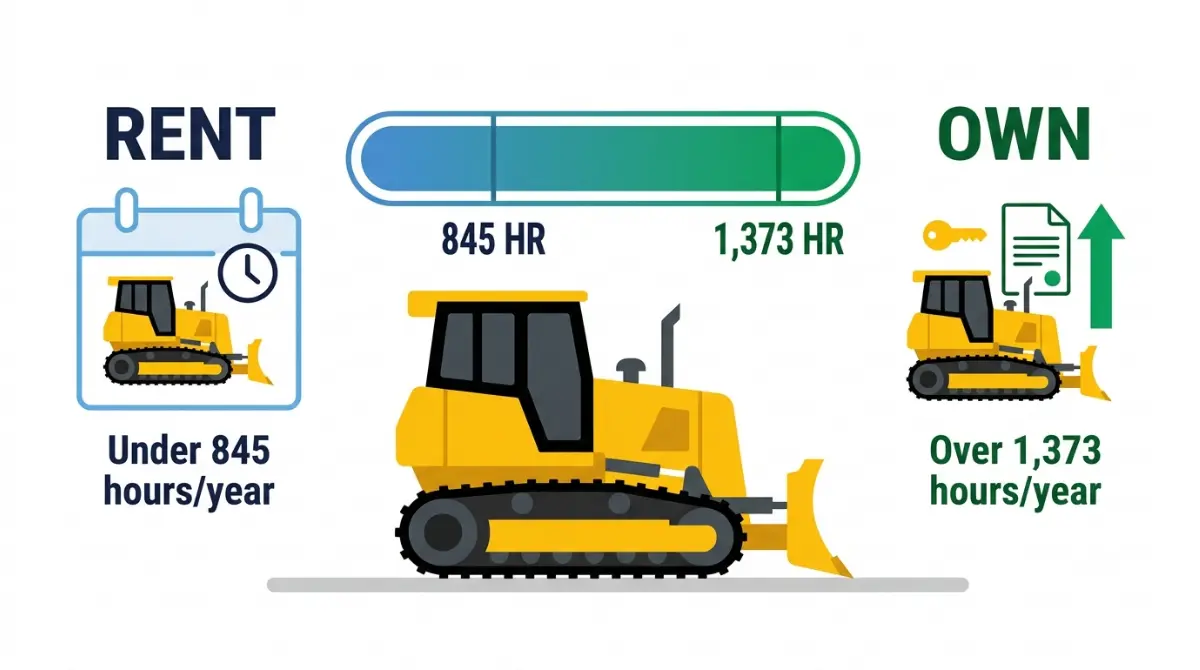
Table of Contents
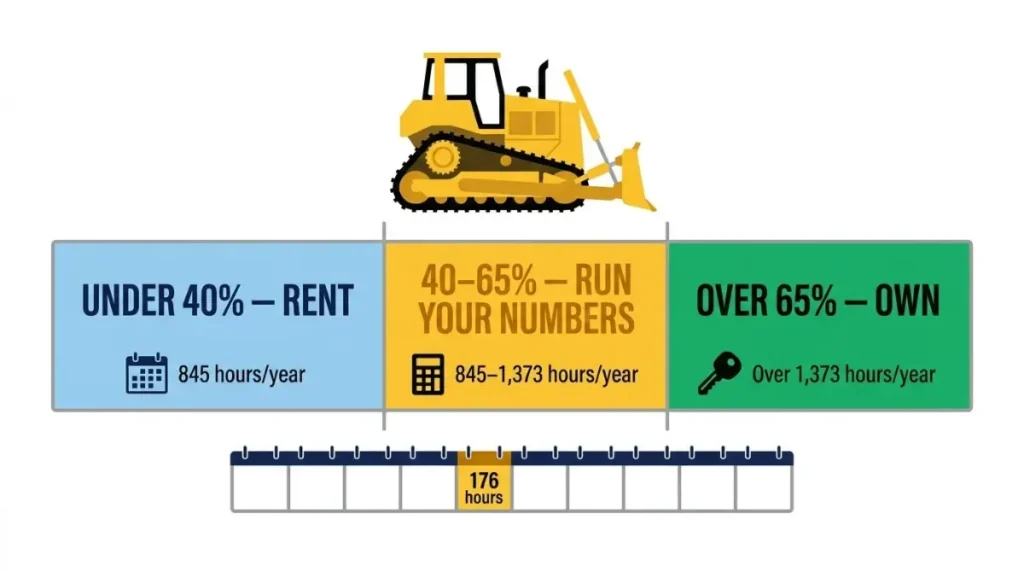
Renting usually wins below about 845 machine hours a year, and owning usually wins above about 1,373. John Deere Financial treats a machine running 22 days or 176 hours a month as 100% utilized, and says that below 40% utilization renting is almost always the better choice; the same guidance marks 65% as the buy zone. Over a full year, 176 × 12 = 2,112 available hours. That makes 40% about 845 hours and 65% about 1,373 hours.
Rent vs buy a dozer: the breakeven in hours
The breakeven hours at a glance
| Use level | Hours per month | Year-round (12 months) | 8-month season | Usual answer |
|---|---|---|---|---|
| Under 40% | Under ~70 | Under ~845 | Under ~563 | Rent |
| 40–65% | ~70–114 | ~845–1,373 | ~563–915 | Run your numbers |
| Over 65% | Over ~114 | Over ~1,373 | Over ~915 | Own |
Source: John Deere Financial utilization guidance (176 hours a month = 100%). Annual and seasonal conversions are Axle & Haul calculations.
Which Deere dozers this covers
| Model | Applies To | Net power | Operating weight | List price |
|---|---|---|---|---|
| 450 P-Tier | Current P-Tier, range across configurations | 71 hp | 17,816–19,035 lb | $172,120 |
| 550 P-Tier | Current P-Tier, range across configurations | 92 hp | 18,853–20,115 lb | $207,788 |
| 650 P-Tier | Current P-Tier, range across configurations | 104 hp | 21,165–22,484 lb | $237,514 |
Source: deere.com small dozer lineup, where list prices are shown plus additional charges. Retrieved October 17, 2026. Deere small dozer specs and pricing.
The mid-size 700, 750 and 850 P-Tier dozers run from 135 to 225 hp and are not priced on deere.com. Get a dealer quote; the same hour thresholds apply. For weights by configuration, see operating weight for every Deere dozer model, or the full John Deere dozer specs by configuration.
ℹ️ Safety Note: Financing a dozer commits you to fixed payments whether the machine works or sits. Every figure here comes from dated public sources, not from your books. Confirm your annual hours from your own job records, and tax treatment with your CPA, before you sign.
What a dozer rental month actually buys you
A monthly rate looks expensive until you divide it by the hours it includes.
| Rental term | Posted rate | Hours included (industry norm) | Effective cost per hour |
|---|---|---|---|
| Day | $1,073 | 8 | $134.13 |
| Week | $2,595 | 40 | $64.88 |
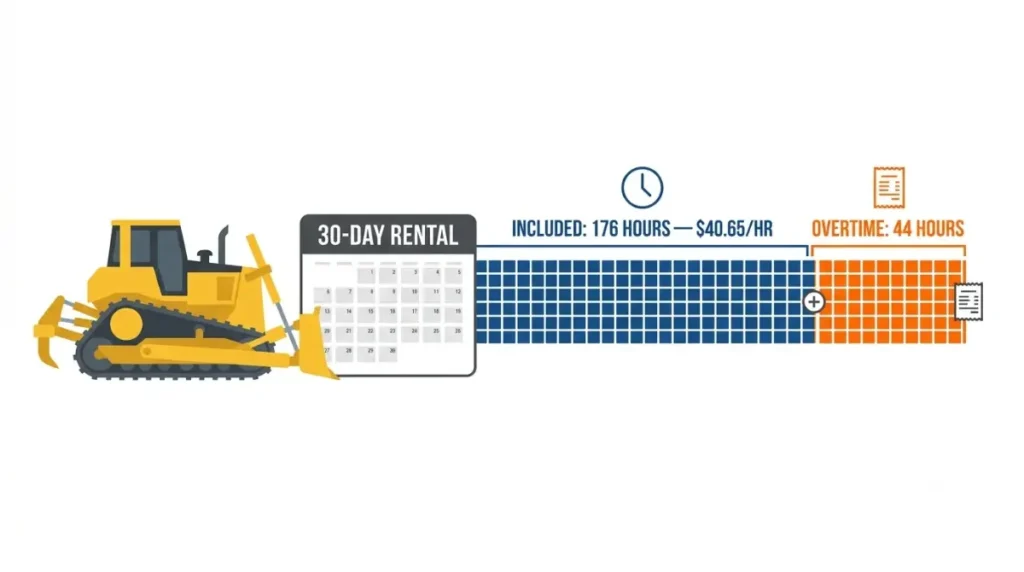
| Month | $7,155 | 176 | $40.65 |
Applies To: a used 2022 Deere 650 LGP P-Tier rental listing in Kentucky (104 hp, 22,484 lb, PAT blade), posted at $1,073/day, $2,595/week and $7,155/month. Retrieved October 17, 2026 from an equipt.com rental listing. Hours per industry norm; your contract governs. Per-hour figures are Axle & Haul calculations.
Hours included in day, week and month rates
The industry norm is a single-shift rate: 8 hours a day, 40 a week, or 176 per 30-day month. Overtime is billed at 1/176 of the monthly rate for each hour over 176, and some lessors use 160 hours per 28-day month instead, per EquipmentWatch. On a 160-hour month, the same $7,155 works out to $44.72 an hour.
Going over the hours
Running 220 hours in a 176-hour month bills 44 overtime hours on top of the base rate. If you regularly run long days, you are paying the overtime that ownership avoids.
Regional rates for a 650-class dozer
🗺️ State Check: Rental rates have no federal baseline; they move by metro, season, and fleet depth.
| Region | Applies To | Day | Week | Month / 4-week |
|---|---|---|---|---|
| Kentucky | Deere 650 LGP P-Tier, posted listing | $1,073 | $2,595 | $7,155 |
| Boston | 80–100 hp class, planning band | $650–$1,050 | $1,400–$2,900 | $3,900–$7,500 |
| Houston | 100–130 hp class, planning band | $750–$1,300 | $2,200–$3,400 | $6,000–$10,000 |
| Denver | 70–110 hp class, planning band | $650–$950 | $1,200–$2,400 | $3,700–$7,200 |
Sources: Kentucky row from the listing above, retrieved October 17, 2026. Boston band for 80–100 hp crawlers, Houston band for 100–130 hp mid-size dozers, and Denver band for 70–110 hp dozers, all compiled by CountBricks and published around March 2026. Bands are budgeting ranges, not quotes.
For your own market, request a written quote that states hours included, the overtime method, delivery, and damage waiver.
Add-ons that raise the real hourly cost
Delivery, pickup, and fuel bill on top of the base rate. Protection plans often add 10–15% of the rental, and environmental or recovery fees often add around 2%.
What owning a Deere dozer costs per hour
Ownership costs come in two kinds: what you pay even when the machine is parked, and what you pay per hour of use.
Fixed costs you pay even when it’s parked
- Depreciation: purchase price minus what it sells for later.
- Interest or the cost of tying up your capital.
- Insurance, storage, and personal property tax, which varies by state.
Costs that rise with every hour
- Fuel, which renters also pay.
- Repairs, service, and undercarriage wear. Under a rental these are mostly the rental company’s cost; as an owner they are yours.
The Caltrans cross-check
California publishes an hourly owning-and-operating rate for equipment. Caltrans says its calculated rate represents the cost of owning and operating the equipment, excludes the operator, and is likely lower than a rental yard’s rate, which can carry extra overhead, profit, and a short-term premium. The current Caltrans Labor Surcharge and Equipment Rental Rates book runs September 1, 2026 through March 31, 2027.
🔍 Why It Matters: The gap between a yard’s rate and your true owning cost is the margin ownership captures. You only collect it on hours the machine actually works.
Worked breakeven: a 650 P-Tier from 500 to 1,500 hours
This calculation finds the depreciation-only floor: the annual hours at which rent paid equals what the machine loses in value. Every other ownership cost pushes the real breakeven higher.
| Input | High-residual case | Low-residual case | Source |
|---|---|---|---|
| Purchase price | $237,514 | $237,514 | deere.com list, Oct 17, 2026 |
| Value after 5 years | 54% ($128,258) | 40% ($95,006) | See note |
| Depreciation per year | $21,851 | $28,502 | Calculated |
| Rental cost per hour | $40.65 | $40.65 | Kentucky monthly ÷ 176 |
| Floor breakeven | ~538 hr/yr | ~701 hr/yr | Calculated |
Residual note: the high case uses 54.2%, the 5-year residual of the winning small track dozer in EquipmentWatch’s 2021 retained-value awards (a ceiling, not a Deere figure). The low case is an illustrative assumption. Your dealer’s buyback or an appraisal sets the real number.
Formula: breakeven hours = annual fixed ownership cost ÷ (rental cost per hour − your per-hour costs a renter wouldn’t pay).
The floor sits below Deere’s 845-hour line because it leaves out interest, insurance, storage, property tax, repairs, and undercarriage. Add those and the crossover climbs into Deere’s 40–65% band, which is why that band is the honest decision zone.
🧮 Run the Numbers: In the Owning vs. Renting Breakeven Calculator, enter your quoted price, expected years held, residual percentage, your quoted monthly rental rate, and last year’s machine hours.
Section 179 and bonus depreciation for a 2026 dozer buy
📜 The Rule: For tax years beginning in 2026, businesses can expense up to $2,560,000 of section 179 property, reduced once total qualifying property placed in service exceeds $4,090,000 (Rev. Proc. 2025-32). 100% bonus depreciation is restored for qualifying property both acquired and placed in service after January 19, 2025.
Tax rules change when ownership pays off, not whether it does. The details are in how Section 179 applies to a Deere equipment purchase.
✅ Do This: Ask your CPA two things: whether the machine must be placed in service by December 31 to count this year, and how state conformity affects your return.
Costs that flip the math: hauling, idle months, resale
Three variables move the breakeven more than any rate quote.
Every move is your bill once you own it
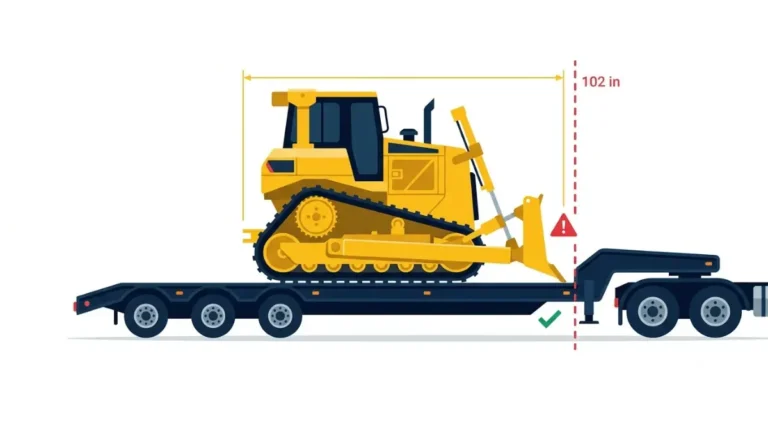
Rental quotes list delivery separately; once you own the machine, every move is your cost. Deere’s 650 P-Tier spec page lists a blade width of 2,921 mm (9 ft 7 in) for the configuration shown, which is 115 inches. Federal rules set vehicle width on the National Network at 102 inches and let states grant permits for vehicles wider than that (23 CFR 658.15).
⚠️ Hazard: A machine loaded at the wrong width or poorly secured can shift or leave the trailer. Hire a licensed carrier for moves, and read oversize permit rules for hauling a dozer by state before you price a move.
Seasonal vs year-round work
Deere notes that a machine used year-round, even at low utilization, can still be better leased or owned than rented, and that how hours spread through the year matters. Over an 8-month season, the 40% line falls to about 563 hours.
What the hours do to resale
As a dated comparison, a 2019 John Deere 650K sold for $72,400 at auction on March 30, 2026; its hours were not stated. Hours and undercarriage condition drive that number more than model year does.
Run your own rent-vs-own numbers before you sign
Six numbers to pull from your records
- Machine hours over the last 12 months.
- Total rental invoices over the same period.
- A written dealer quote, including freight and setup.
- How many years you plan to keep the machine.
- How many moves between jobs per year.
- How many months a year you actually work.
When rent-to-own or a lease fits better
If you’re in the 40–65% band and unsure your backlog will hold, ask the dealer about rental-purchase options. Some credit part of the rent toward the purchase. Get the credit terms in writing.
FAQ
1. Is it cheaper to rent or buy a dozer?
Renting a dozer usually wins below about 845 hours a year, and buying usually wins above about 1,373, per Deere’s utilization guidance.
2. What is the utilization rule for buying a dozer?
John Deere Financial counts 176 hours a month as full use, says renting almost always wins under 40%, and marks 65% as the buy zone.
3. How many hours are in a monthly dozer rental?
A monthly dozer rental typically includes 176 hours per 30-day month, though some rental companies use 160 hours per 28-day month.
4. What happens if I run a rental dozer past its hours?
Under the common method, each hour over 176 is billed at 1/176 of the monthly rental rate. Check your contract’s overtime terms.
5. How much does a new John Deere 650 P-Tier cost?
Deere listed the 650 P-Tier at $237,514 plus additional charges, as retrieved October 17, 2026. Dealer prices vary.
6. What does it cost per hour to own a dozer?
Your hourly owning cost is fixed costs (depreciation, interest, insurance, storage, tax) divided by annual hours, plus fuel, repairs and undercarriage wear.
7. Can I deduct a dozer bought in 2026?
For 2026, Section 179 allows expensing up to $2,560,000, and 100% bonus depreciation applies to qualifying property. Confirm with your CPA.
8. Does seasonal work change the rent vs buy answer?
Yes. Over an 8-month season, the dozer rent-or-buy thresholds fall to roughly 563 and 915 hours a year.
9. Who pays to haul the dozer when I own it?
You do; dozer rental quotes list delivery separately. A 650 P-Tier’s listed 115-inch blade exceeds the federal 102-inch width limit. Use a licensed carrier.
10. What are used Deere 650K dozers selling for?
A 2019 Deere 650K sold for $72,400 at auction on March 30, 2026. Hours and undercarriage condition drive used dozer value.
The decision comes down to your hours
If you’re paying rent month after month on the same dozer class, your own hour log answers this better than any rule of thumb. Pull last year’s hours, set them against the 845 and 1,373 lines, then run the breakeven with real quotes.
Once you own the machine, moving it is your job and your cost. Start with oversize permit rules for hauling a dozer by state; if yours is an 850, see how to haul a John Deere 850L legally. For full machine specs, the John Deere dozer specs by configuration reference has every model.
Before signing, have your CPA confirm placed-in-service timing for this tax year, and ask the dealer for a written buyback or residual estimate.