John Deere 310SL vs 310SK Backhoe Specs With the Correct Weights

John Deere 310SL vs 310SK, generation by generation: base weight 15,872 lb (redesigned 310SL) vs 14,708 lb, plus the federal four-tiedown minimum.
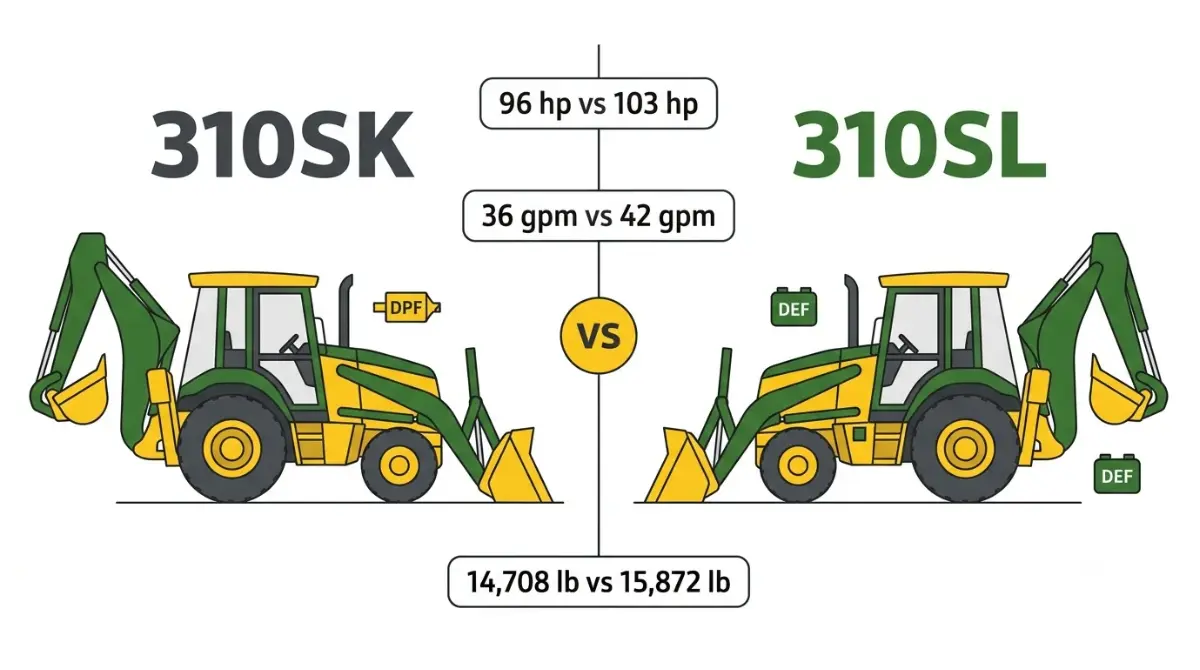
Table of Contents
310SL vs 310SK: the differences that matter, in one table
The 310SL succeeded the 310SK in Deere’s backhoe line, and every “310SL” value below is for the redesigned machine. It lists 103 hp, 42 gpm and 15,872 lb; the 310SK lists 96 hp, 36 gpm and 14,708 lb. The 310SK digs 3 inches deeper on the standard stick. Two 310SL generations exist, so confirm the engine model before trusting any spec.
Side by side
| Spec | 310SK | 310SL (redesigned) | Applies To |
|---|---|---|---|
| Net peak power | 72 kW (96 hp) at 2,000 rpm | 77 kW (103 hp) at 1,600 rpm | Std engine |
| Peak torque | 295 lb-ft at 1,400 rpm | 339 lb-ft at 1,600 rpm | Std engine |
| Pump flow | 36 gpm backhoe, 28 gpm loader | 42 gpm both | At 2,200 rpm |
| Base operating weight | 14,708 lb (6,671 kg) | 15,872 lb (7,199 kg) | Std equipment |
| SAE max dig depth | 14 ft 6 in (4.42 m) | 14 ft 3 in (4.35 m) | Std dipperstick |
| Emissions | Interim Tier 4: EGR, DOC, DPF | Final Tier 4: DOC, SCR, DEF | Per Deere |
Source: Deere K-Series backhoes brochure (print 10-15-15); Deere L-Series backhoes brochure (rev. 03-30-21). Verified October 12, 2026.
Where to go next, by reader type
Buying used: see the DPF vs DEF section. Hauling: see the hauling section. Comparing performance: see the engine and hydraulics section.
ℹ️ Safety Note: Raised loader arms and backhoe booms can drop if hydraulic pressure is lost, crushing anyone beneath them, and a poorly secured machine can shift or roll during hauling. The information here is for general understanding; have a qualified technician or licensed carrier do this work and follow the machine’s operator’s manual.
Which 310SL? The redesign changed the machine
Two machines carry the 310SL name, and published specs often mix them.
310SL before and after the redesign
Deere’s brochure calls the 310SL “newly redesigned,” and Heavy Equipment Guide reported on November 18, 2020 a PowerTech EWL engine without EGR, PCLS hydraulics, Lift Mode and standard AutoShift. The earlier 310SL had no PCLS hydraulics; we did not obtain its figures, so none are shown.
Dealer pages list 310SL power as both 99 hp and 103 hp, and aggregator weights run 14,669–16,549 lb, so mixed generations are a likely cause; check the engine plate (4045HL050 on the redesigned unit).
Deere’s newer tier names are explained in what Deere’s P-Tier naming means, and other models in Deere construction equipment specs by configuration.
310SL vs 310SL HL
The 310SL HL lists 84 kW (113 hp), 16,571 lb base and a 15 ft 1 in dig depth; Deere claims up to 25% more rear-craning capacity than the 310SL.
310SK vs 310SK TC
The 310SK TC tool carrier lists 76 kW (102 hp), PCLS hydraulics at 42 gpm and 19,855 lb as equipped.
Engine, torque and hydraulic flow compared
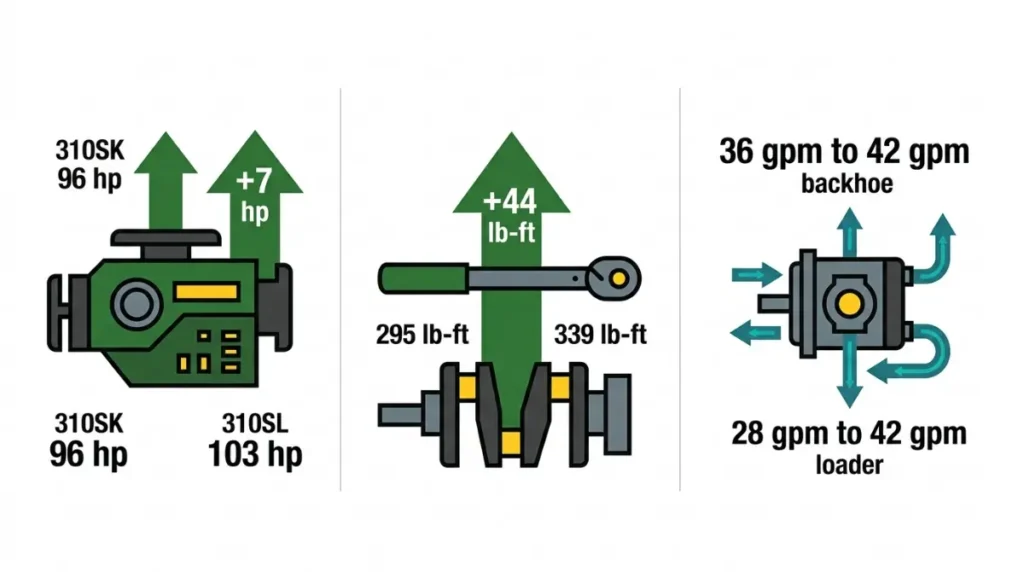
The redesigned 310SL gains more in torque and flow than in horsepower.
| Spec | 310SK | 310SL | Difference | Applies To |
|---|---|---|---|---|
| Net power | 96 hp | 103 hp | +7 hp (+7.3%; 7 ÷ 96) | Std engine |
| Torque | 295 lb-ft | 339 lb-ft | +44 lb-ft (+14.9%; 44 ÷ 295) | Std engine |
| Backhoe flow | 36 gpm | 42 gpm | +6 gpm (+16.7%; 6 ÷ 36) | At 2,200 rpm |
| Loader flow | 28 gpm | 42 gpm | +14 gpm (+50%; 14 ÷ 28) | At 2,200 rpm |
| Relief pressure | 3,625 psi | 3,625 psi | Same; 4,000 psi in Lift Mode | Per Deere |
Source: Deere K-Series and L-Series brochures. Percentages calculated from the inputs shown. Verified October 12, 2026.
Engine and torque
The 310SK runs a 4045HT073; the 310SL, a 4045HL050 that makes its peak torque 200 rpm higher.
Gear pump vs PCLS: what 42 gpm means
The 310SK uses a tandem gear pump with separate backhoe and loader flows. The 310SL’s pressure-compensated load-sensing (PCLS) pump sends each function only the oil it asks for, up to 42 gpm for both circuits. Deere’s 16% trenching productivity claim is against the prior 310SL, not the 310SK.
Lift Mode
Deere says Lift Mode raises relief pressure to 4,000 psi and sets engine speed at 1,400 rpm for 10–15% more lift; check the operator’s manual for its effect on any lift.
Weight, size and dig depth, configuration by configuration
Deere’s printed “typical” weights are 17,258 lb for the 310SK and 17,692 lb for the 310SL, but the setups differ, so this table rebuilds both the same way.
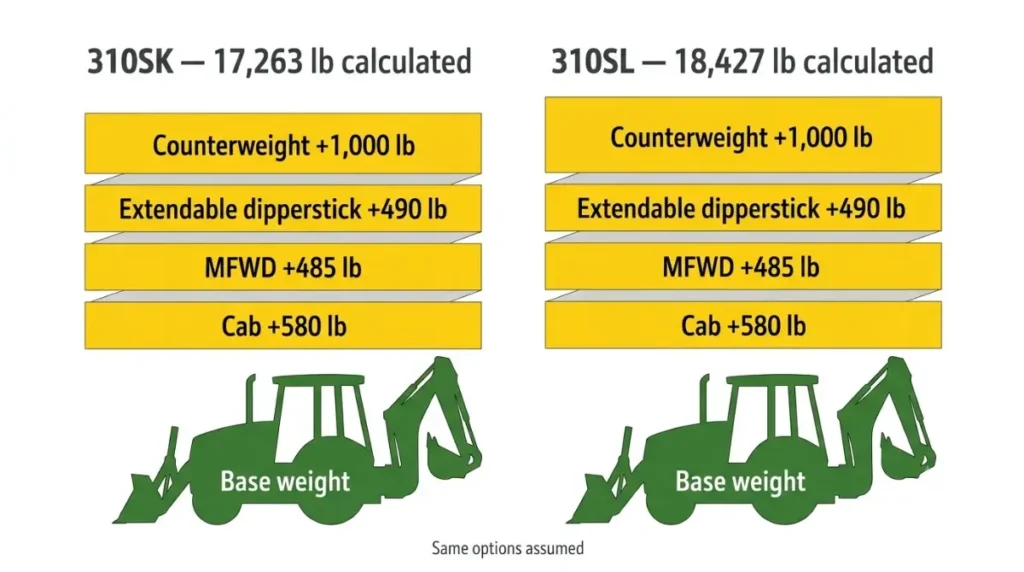
Like-for-like operating weight
| Item | 310SK | 310SL | Applies To |
|---|---|---|---|
| Base weight | 14,708 lb | 15,872 lb | Std equipment |
| Cab | +580 lb | +580 lb | Deere option weight |
| MFWD | +485 lb | +485 lb | Deere option weight |
| Extendable dipperstick | +490 lb | +490 lb | Deere option weight |
| Counterweight | +1,000 lb | +1,000 lb | Assumed same |
| Total, calculated | 17,263 lb | 18,427 lb | Fully equipped |
Calculated from option weights in Deere’s K-Series and L-Series brochures; the 310SK total differs from Deere’s printed 17,258 lb by 5 lb. Deere’s 310SL “typical” omits MFWD and uses a 750 lb counterweight. Verified October 12, 2026.
Equipped alike, the 310SL is about 1,165 lb heavier, matching the 1,164 lb (+7.9%) base gap. Confirm option availability with a Deere dealer.
Dig depth: the SK is 3 inches deeper
On the standard dipperstick the 310SK digs 14 ft 6 in versus 14 ft 3 in; extended, 18 ft 5 in versus 18 ft 2 in, with the same test bucket.
Size, fuel, and fluids
Dimensions are in the hauling table. Fuel tanks hold 41 gal (310SK) and 34 gal (310SL); hydraulic systems hold 23.6 and 33.5 gal.
Lift capacity: why the two Deere charts don’t match up
Per Deere’s K-Series and L-Series brochures, loader full-height lift is 7,353 lb for the 310SK and 7,698 lb for the 310SL with a 1.12 cu yd heavy-duty bucket, a difference of 345 lb (+4.7%; 345 ÷ 7,353), but the brochures print different lift bases.
Backhoe lift: 87% vs 100% charts
The K-Series brochure states its lift figures are 87% of the maximum lift force available; the L-Series brochure states 100%.
🔍 Why It Fails: An 87% chart and a 100% chart are different yardsticks. If scaling is linear, 1 ÷ 0.87 ≈ 1.15, so a raw comparison could overstate the 310SL’s advantage by up to roughly 15%; this is illustrative arithmetic, not a rating.
⚠️ Hazard: A load lifted on a backhoe can swing, drop or tip the machine, striking or crushing anyone nearby. These charts are manufacturer ratings, not a lift plan; a certified rigger or safety professional builds the plan from the operator’s manual and decals. Ask which lift basis your machine’s chart uses.
What the OSHA crane standard does and doesn’t cover
📜 The Rule: OSHA’s construction crane standard (Subpart CC) excludes backhoes and loader backhoes, including when used with chains, slings or other rigging to lift suspended loads. Source: OSHA crane-standard scope and exclusions, 29 CFR 1926.1400(c)(2); current to October 7, 2026.
That exclusion describes the standard’s scope only. Follow the operator’s manual and consult a qualified rigger.
Hauling each machine: weight, height and the four-tiedown rule
Give your hauler these machine-only figures first.
Weight and dimensions to give your hauler
| Item | 310SK | 310SL | Applies To |
|---|---|---|---|
| Base weight | 14,708 lb | 15,872 lb | Std equipment |
| Equipped weight | 17,263 lb | 18,427 lb | Calculated, Section 4 |
| Length | 23 ft 6 in | 23 ft 11 in | Machine only |
| Width over tires | 7 ft 2 in | 7 ft 3 in | Machine only |
| Height | 11 ft 6 in | 11 ft 5 in | Machine only |
Source: Deere K-Series and L-Series brochures; verified October 12, 2026. Loaded height = machine height + deck height: ____ ft ____ in.
🧮 Run the Numbers: Enter the weight, width and height above plus your deck height into the Trailer Capacity Matcher. The same weight-to-tiedown check for a dozer is in John Deere 700L weight and tie-down points.
The federal securement rule for 10,000 lb and up
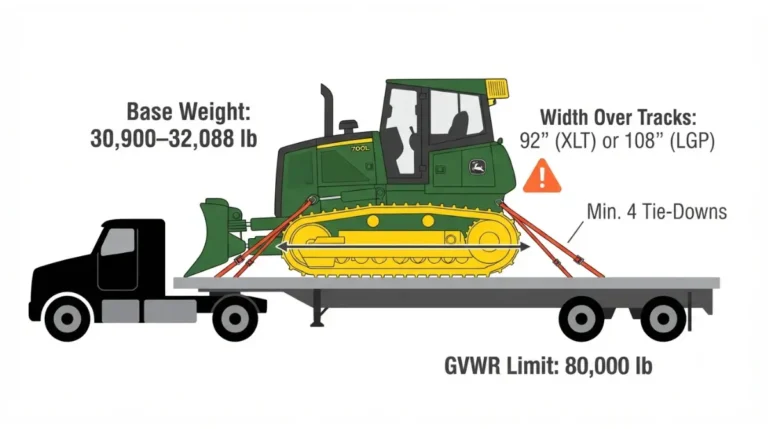
📜 The Rule: Under the federal securement rule for heavy machinery, 49 CFR 393.130, equipment of 10,000 lb or more needs accessory equipment completely lowered and secured and at least four tiedowns restraining lateral, forward, rearward and vertical movement. Section 393.128 covers 10,000 lb or less. Current to October 8, 2026.
Both machines exceed 10,000 lb, and Deere lists four tie-downs (two front, two rear) as standard. Four is a minimum, not a securement plan.
⚠️ Hazard: A machine that shifts on the deck can slide off, roll the trailer or strike traffic. A licensed heavy-haul carrier sets tiedown points, ratings and loaded height for the actual trailer; ask the carrier to confirm total tiedown rating against your equipped weight, and loaded height on your route.
Height varies by state
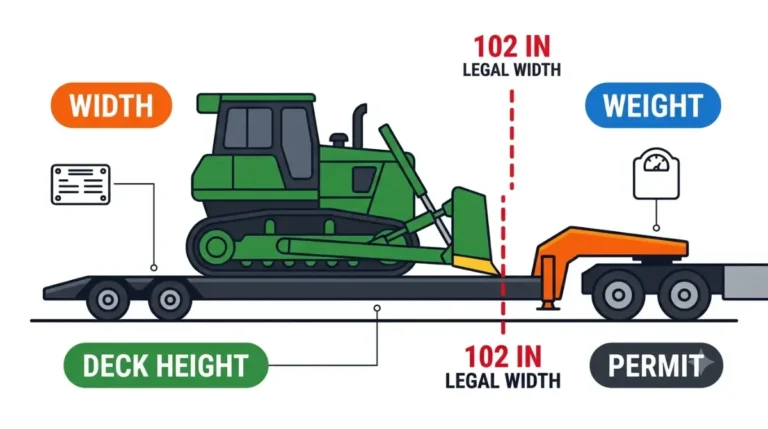
🗺️ State Check: Each state sets its own maximum vehicle height. Texas: 14 ft (Tex. Transp. Code § 621.207). California: 14 ft (Cal. Veh. Code § 35250). Ohio: 13 ft 6 in with or without load (Ohio Rev. Code § 5577.05(D)). Subtracting machine height leaves 24 in of deck height for the 310SK in Ohio and 30 in in Texas or California; the 310SL leaves 25 in and 31 in. Look up each route state’s maximum-height statute. Verified October 12, 2026.
Buying used: DPF vs DEF, hours and a fair price
Yes, the redesigned 310SL uses DEF: Deere’s L-Series brochure lists a 3.6 gal (13.7 L) tank, while the 310SK uses a DPF and EGR instead.
DPF vs DEF: what each owner maintains
The 310SK’s diesel particulate filter (DPF) traps soot; Deere says ash cleaning is condition-based and done by the dealer when lights or codes indicate. The 310SL’s selective catalytic reduction (SCR) system uses diesel exhaust fluid (DEF), and Deere says its concentration sensor alerts of a potential engine derate.
📜 The Rule: Both machines were certified under EPA’s Tier 4 nonroad diesel regulations (40 CFR Part 1039; page updated March 11, 2026). Defeating emissions controls is a compliance problem and cuts resale value.
Hours and price: what to compare
No dated price pull supports a figure, so none is published. On October 12, 2026, same-year 310SK listings on one marketplace showed a wide asking-price spread at similar hours, so no single value fits.
An Equipment World owner review from around 2017 (11 owners, 57,200+ combined hours, 8.6 overall) scored emissions control and fuel efficiency below that overall score, and it predates the redesigned 310SL.
🧮 Run the Numbers: Enter model, year and hours into the Used Equipment Hour-Value Estimator.
What to ask the seller
- Which engine model is on the plate: 4045HT073 (310SK) or 4045HL050 (310SL)?
- For a 310SK, where is the dealer record of DPF ash cleaning?
- For a 310SL, have any DEF-quality or derate alerts occurred?
- Is every emissions component original and intact?
✅ Do This: Have an equipment appraiser value the specific unit and a Deere dealer technician read its aftertreatment status and service history before you commit.
310SL vs 310SK FAQ
1. Is the John Deere 310SL bigger than the 310SK?
Yes. In the 310SL vs 310SK comparison, Deere lists 15,872 lb base versus 14,708 lb, a 1,164 lb difference.
2. Which has more horsepower, 310SL or 310SK?
The redesigned 310SL lists 103 hp net at 1,600 rpm; the 310SK lists 96 hp net at 2,000 rpm.
3. Does the 310SL dig deeper than the 310SK?
No, on Deere’s standard-dipperstick figures: 14 ft 6 in for the 310SK versus 14 ft 3 in for the 310SL.
4. How much more hydraulic flow does the 310SL have?
The redesigned 310SL lists 42 gpm versus 36 gpm backhoe flow on the 310SK, about 17% more.
5. Does the 310SK use DEF?
The 310SK brochure lists EGR, DOC and DPF with no DEF tank; the redesigned 310SL lists SCR and a 3.6 gal DEF tank.
6. What is a 310SL HL?
The heavy-lift 310SL HL lists 113 hp, 16,571 lb base, 15 ft 1 in dig depth and, per Deere, up to 25% more craning.
7. How many tiedowns to haul a 310SL or 310SK?
49 CFR 393.130 requires at least four tiedowns for equipment of 10,000 lb or more, which covers both the 310SL and 310SK. Confirm the securement plan with a licensed heavy-haul carrier.
8. Does OSHA’s crane standard cover backhoe loaders?
OSHA’s Subpart CC crane standard excludes backhoes and loader backhoes, including when used with rigging to lift suspended loads. Follow the operator’s manual and consult a qualified rigger.
9. How much does a loaded 310SL weigh?
Deere’s typical 310SL (cab, extendable dipperstick, 750 lb counterweight) is 17,692 lb; with MFWD and a 1,000 lb counterweight instead, it calculates to 18,427 lb.
10. Is a 2019 310SL the same as a 2023 310SL?
Not necessarily. Deere announced a redesigned 310SL with a new engine in November 2020; confirm the 310SL engine model before trusting any spec.
Which one fits your jobs
You are likely weighing a used unit or sizing a trailer. The 310SL gives more torque, flow and weight in return for DEF upkeep; the 310SK is lighter, digs 3 inches deeper on the standard stick and uses a DPF.
For the next question, what trailer a 310SL needs, use the hauling table and the Trailer Capacity Matcher (weight, width, height, length); other Deere models are in the specs-by-configuration reference linked above. Before buying, have a Deere dealer technician confirm the engine model and aftertreatment history; before hauling, have a licensed carrier confirm tiedowns and loaded height.